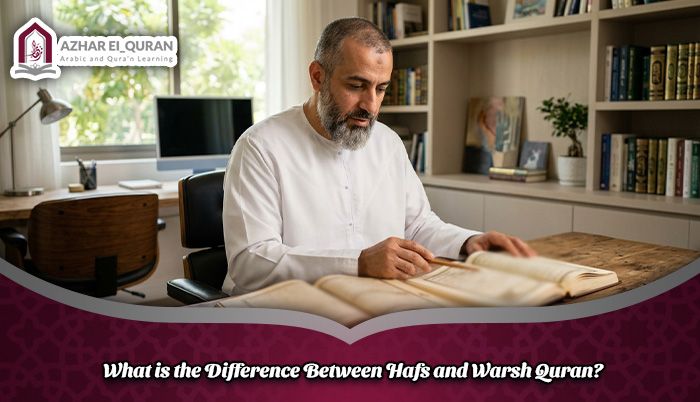
Hafs and Warsh Quran are two of the most widespread and authentic methods (riwayat) of reciting the Quran. While the core message and text are identical, they differ in regional popularity, Tajweed rules (such as vowel lengths and glottal stops), and occasional spelling variations that reflect authentic Arabic dialects.
Hafs is widely used across most Muslim-majority regions, while Warsh is predominant in West and North-West Africa. Though both are authentic and rooted in the Quranic text, minor variations exist in wording and meaning, though these do not alter core Islamic teachings.
Many Muslims notice small differences between these two forms of Quran recitation and wonder if they represent different Qur'ans. This question is common among beginners, new Muslims, parents, and even students who want to understand the science of Qira'at. The simple answer is no.
The difference between Hafs and Warsh Quran does not mean there are different versions of the Holy Quran. Instead, these are two authentic and accepted canonical readings that have been preserved through reliable chains of transmission since the time of the Prophet Muhammad (peace be upon him).
The small differences appear in pronunciation, vowels, elongation, and a limited number of words. These textual variants never change the core meaning or teachings of Islam. They reflect the richness and flexibility of the Arabic language that Allah allowed for ease of recitation among different Arab tribes.
In this article, you will discover the difference between Hafs and Warsh Quran, explore their origins, understand their recitation styles, and learn why Muslim scholars accept both readings. You will also see how Azhar El-Quran Academy, a leading platform, helps students of every age master both authentic Hafs and Warsh Quran recitations with confidence.
What Are Hafs and Warsh Quran Recitations?
The Hafs and Warsh Quran are two authentic riwayah, or methods of transmitting the Holy Quran through oral recitation. They belong to the science of Qira'at, which preserves the different accepted readings taught by the Prophet Muhammad (peace be upon him). These recitations were passed from one generation to another through trusted scholars who memorized every letter, vowel, and rule of pronunciation. The Hafs recitation comes through Hafs ibn Sulayman, who learned from Imam Asim, one of the ten famous imams of the canonical Quran readings.
The Warsh recitation comes through Warsh ibn Nafi', who transmitted the reading of Imam Nafi' of Madinah. This is the main difference between the Hafs and Warsh Quran from the perspective of transmission. Both methods preserve the same divine Qur'an, and both are accepted by scholars across the Muslim world.
The differences between the Hafs and Warsh methods appear only in specific aspects of reading, such as vowels, pronunciation, and a small number of words. These variations were revealed as part of the different accepted forms of recitation to make the Quran easier for different Arab tribes to read. They do not introduce a new chapter, remove a verse, or change any essential teaching.
For this reason, Muslims who follow either the Hafs version or the Warsh Quran worship with complete confidence. Understanding the difference between Hafs and Warsh recitation helps students appreciate the beauty of the Quran and recognize that its authentic transmissions represent one perfectly preserved revelation rather than multiple conflicting versions.
History and Origins of Hafs and Warsh
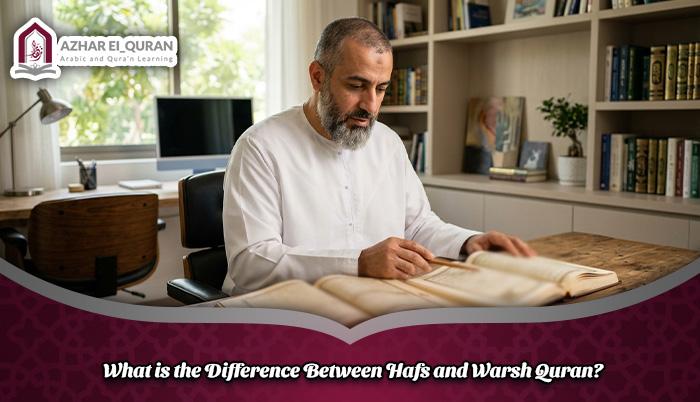
The history of the Hafs and Warsh Quran begins during the lifetime of the Prophet Muhammad (peace be upon him). The Angel Jibril taught the Prophet the Quran, and the Prophet then taught it to his companions. They memorized every verse, practiced the correct pronunciation, and passed the Quran recitation to the next generation with great care.
As Islam spread among Arab tribes, Allah allowed several accepted qira'at, or canonical readings, to make the Quran easier to recite in different Arabic dialects. These multiple forms did not create different versions of the Quran. Instead, they preserved one revelation through different authentic transmissions.
The Hafs recitation traces back to Hafs ibn Sulayman, who learned from Imam Asim in Kufa. The Warsh recitation comes through Warsh ibn Sa'id, who studied under Imam Nafi' in Madinah. Their students carefully preserved every detail and passed these readings to later generations.
Over time, the Hafs version became the dominant method in much of the Muslim world, while the Warsh Quran remained widely practiced across North and West Africa. Muslim scholars documented these authentic riwayah in trusted books and educational documents to ensure their preservation. This rich history explains the difference between the Hafs and Warsh Quran and shows that both recitations have strong scholarly foundations.
Today, millions of Muslims continue to read both forms with confidence, knowing they represent authentic and accepted recitations of the same Holy Qur'an.
The Main Differences Between Hafs and Warsh Quran
The difference between Hafs and Warsh Quran lies in the method of transmission and certain aspects of Quran recitation, not in the message or teachings of the Holy Quran. Both are authentic canonical readings that trace back to the Prophet Muhammad (peace be upon him). The table below highlights the key differences between the two recitations.
|
Feature |
Hafs Recitation |
Warsh Recitation |
|
Transmitted By |
Hafs ibn Sulayman |
Warsh ibn Sa'id |
|
Primary Teacher (Imam) |
Imam Asim |
Imam Nafi' |
|
Type of Transmission |
Riwayah 'an Asim |
Riwayah 'an Nafi' |
|
Geographic Distribution |
Dominant in the Middle East, Asia, Europe, and many other regions |
Common in North and West Africa, especially Morocco, Algeria, Mauritania, and parts of Sudan |
|
Popularity |
The most widely used Quran recitation worldwide |
The second most widely practiced authentic recitation |
|
Pronunciation |
Follows the pronunciation rules of Hafs with specific vowel patterns and elongations |
Includes different vowel lengths, hamzah pronunciation, and some unique Tajweed applications |
|
Quranic Words |
Uses certain accepted word forms in specific verses |
Uses alternative authentic word forms in the same verses |
|
Textual Variants |
Contains authentic textual variations transmitted from Imam Asim |
Contains authentic textual variations transmitted from Imam Nafi' |
|
Meaning |
Preserves the same message and teachings of the Quran |
Preserves the same message and teachings of the Quran |
|
Tajweed Rules |
Slightly different in some areas of madd, imalah, and hamzah |
Applies its own accepted Tajweed rules according to the Warsh tradition |
|
Acceptance |
Universally accepted by Muslim scholars |
Universally accepted by Muslim scholars |
|
Status |
One of the ten canonical Quran readings |
One of the ten canonical Quran readings |
Although there are several differences between the Hafs and Warsh traditions, these variations are limited to pronunciation, vowels, and a small number of words. They do not change the beliefs, rulings, or core meaning of the Holy Quran. Both the Hafs recitation and Warsh recitation remain authentic, preserved, and accepted by Muslims around the world.
Differences in Pronunciation and Tajweed Rules
One of the most noticeable aspects of the difference between Hafs and Warsh Quran is the way certain words are pronounced during Quran recitation. Each recitation follows precise Tajweed rules that scholars have preserved through continuous oral teaching.
The Hafs recitation uses clearer vowel sounds that many students around the world learn first. The Warsh recitation includes several unique features, such as different methods of lengthening vowels, pronouncing certain hamzah letters, and reading specific words according to the transmission of Imam Nafi'. These differences are carefully defined and do not result from personal preference. Instead, they are part of authentic qira'at that have been passed down through reliable teachers.
Students learning the Hafs and Warsh Quran quickly discover that every rule has evidence from qualified scholars. Although the pronunciation may differ, the overall meaning of the verses remains unchanged. The beauty of these styles reflects the richness of classical Arabic and the wisdom behind preserving more than one accepted method of recitation.
Beginners should remember that mastering either recitation requires listening to experienced teachers and practicing regularly. As confidence grows, students often enjoy comparing the Hafs recitation and Warsh recitation to understand their unique features. This process strengthens their connection with the Quran and deepens their appreciation for the precision with which every authentic reading has been preserved throughout Islamic history.
Differences in Quran Words and Recitation Styles
Another important part of the difference between Hafs and Warsh Quran involves a small number of Quranic words and recitation styles. These are among the most discussed topics in the science of Qira'at. In a limited number of verses, the Hafs recitation and Warsh recitation use different accepted grammatical forms, vowel patterns, or word endings. For example, one reading may use a singular expression while another uses a plural one. In another verse, one recitation may read a verb in a slightly different form.
These variations are authentic and have been accepted by scholars for centuries. They never introduce conflicting beliefs or change the message of the Qur'an. Instead, they enrich its linguistic beauty and highlight the depth of the Arabic language. Some famous examples include verses in Surah Al-Fatihah and several other chapters, where the wording differs slightly while conveying the same essential guidance.
These textual variants complement one another rather than compete with each other. Students who learn both forms often gain a broader understanding of Quranic expression and interpretation. Exploring the difference between Hafs and Warsh recitation also helps readers appreciate why multiple authentic readings continue to exist today. Every accepted riwayah follows strict scholarly standards and forms part of the preserved canonical tradition of the Holy Quran, making both Hafs and Warsh Quran equally valuable for Muslims around the world.
Where Are Hafs and Warsh Recitations Commonly Used?
Today, the Hafs and Warsh Quran are recited by millions of Muslims across the world. Although both are authentic and accepted, each has become more common in certain regions because of historical teaching traditions. The Hafs recitation is the dominant form in countries such as Saudi Arabia, Egypt, Turkey, Pakistan, India, Indonesia, Malaysia, and many other parts of Asia and the Middle East. It is also the standard recitation used in many printed copies of the Quran and most digital applications.
As a result, many beginners first learn the Hafs version when they begin studying the Holy Quran. In contrast, the Warsh Quran remains the preferred reading in much of North and West Africa, especially in Morocco, Algeria, Mauritania, and parts of Tunisia. The Warsh recitation is also found in some communities in Libya and neighboring countries. In Sudan, both recitations can be found depending on local educational traditions. Despite these regional preferences, the difference between Hafs and Warsh Quran does not create division among Muslims.
Scholars from every major school of Islamic thought, including Hanafi scholars, recognize both as authentic canonical readings. Students who travel or study abroad may hear different recitations, but they are all reciting the same divine revelation. Learning where the Hafs and Warsh Quran are commonly used helps readers appreciate the diversity of Islamic scholarship while understanding that all authentic transmissions preserve the same message revealed to the Prophet Muhammad (peace be upon him).
Are Hafs and Warsh Different Versions of the Quran?
One of the most common questions people ask is whether the Hafs and Warsh Quran are different versions of the Holy Quran. The answer is clear: they are not. There is only one Qur'an, and both the Hafs recitation and the Warsh recitation preserve that same revelation. The difference between Hafs and Warsh Quran lies only in authentic readings that were taught by the Prophet Muhammad (peace be upon him).
These accepted variants include slight differences in pronunciation, vowel markings, and a small number of words. They never change the beliefs, laws, or central meaning of Islam. Every Surah, every chapter, and every essential teaching remains the same. This is why Muslim scholars describe Hafs and Warsh as different riwayah, not different books.
Throughout Islamic history, scholars carefully preserved these transmissions through memorization and written documents. Their efforts ensured that each authentic Quran manuscript reached later generations without alteration. Modern researchers continue to study these textual features and confirm that they reflect authentic canonical recitations rather than conflicting scriptures. Understanding this point removes confusion for many beginners and strengthens confidence in preserving the Holy Quran. The Hafs and Warsh Quran demonstrate the richness of Quranic recitation rather than disagreement. They are two accepted forms of the same divine revelation that Muslims have faithfully read and memorized for more than fourteen centuries.
Which Is More Authentic: Hafs or Warsh?
Many students ask whether one recitation is more authentic than the other. Islamic scholars agree that both the Hafs and Warsh Quran are equally authentic because both were transmitted through reliable chains of narration and accepted by the scholars of Qira'at.
The difference between Hafs and Warsh Quran does not make one superior to the other. Instead, each belongs to the recognized canonical readings that trace back to the Prophet Muhammad (peace be upon him). The Hafs recitation became more popular because it spread widely through education, printing, and the publication of the King Fahd Complex Mushaf. This widespread use does not mean the Warsh recitation is less authentic. In fact, generations of scholars in Africa and other regions have preserved the Warsh Quran with the same level of care and precision.
Every authentic reading follows strict rules of transmission, and every accepted riwayah has qualified teachers who continue to teach it today. Muslims are therefore free to read either recitation as long as they learn it correctly from knowledgeable instructors. Rather than comparing them as competing versions, students should view them as complementary forms of the same revelation. Exploring the difference between Hafs and Warsh recitation helps readers appreciate the wisdom behind preserving multiple authentic recitations. Both methods enrich a student's understanding of the Holy Quran and demonstrate the remarkable accuracy with which Allah's words have been preserved throughout Islamic history.
How to Learn Hafs and Warsh Quran Recitation
Learning the Hafs and Warsh Quran is an exciting journey that helps students connect more deeply with the words of Allah. Beginners should start by mastering one authentic reading before exploring another. Since the Hafs recitation is the most widely taught around the world, many students begin with it.
After building confidence in Tajweed and pronunciation, they can study the Warsh recitation to understand the accepted differences between the two traditions. Learning from a qualified teacher is essential because authentic Quran recitation depends on direct oral instruction. Listening carefully, repeating verses daily, and receiving corrections help students develop accuracy and confidence.
It is also helpful to compare selected examples from both recitations to understand how the difference between Hafs and Warsh Quran appears in practice. Students should avoid relying only on videos or written materials. Instead, they should seek teachers who hold a recognized ijazah or certification in Qira'at. A successful learning plan often includes:
- Daily Quran reading with Tajweed practice.
- Listening to skilled Hafs and Warsh reciters.
- Memorizing short surahs before moving to longer passages.
- Reviewing lessons regularly with a qualified instructor.
- Practicing patiently and consistently every day.
With dedication and proper guidance, students of every age can master the Hafs and Warsh Quran and appreciate the beauty of both authentic recitations while strengthening their relationship with the Holy Quran.
Learn Qiraat Quran with Azhar El-Quran Academy
If you want to master the Hafs and Warsh Quran, choosing the right teacher is just as important as choosing the right course. Azhar El-Quran Academy is a leading platform for students who wish to learn authentic Quran recitation from qualified instructors. The academy offers structured courses for children, adults, beginners, and advanced learners.
Every lesson focuses on correct pronunciation, Tajweed, and the principles of authentic Qira'at. Students can begin with the Hafs recitation and later explore the Warsh recitation under the guidance of experienced teachers who specialize in both transmissions. Interactive online classes make learning simple, regardless of where you live. Teachers provide individual feedback, regular practice sessions, and step-by-step instruction that help students understand the difference between Hafs and Warsh Quran with clarity and confidence. The curriculum combines traditional Islamic scholarship with modern teaching methods, making it suitable for learners of all ages.
Whether your goal is to improve your daily reading, memorize the Quran, or study the accepted canonical readings, the academy provides the support you need. By learning the Hafs and Warsh Quran from trusted scholars, students gain confidence in their recitation and a deeper appreciation for the preservation of Allah's Book. If you are ready to discover the beauty of authentic Quranic recitations, Azhar El-Quran Academy offers the knowledge, guidance, and encouragement to help you succeed on your journey with the Holy Quran.
Conclusion
Understanding the difference between Hafs and Warsh Quran helps Muslims appreciate the richness and preservation of the Holy Quran. Both Hafs recitation and Warsh recitation are authentic canonical readings that trace back to the Prophet Muhammad (peace be upon him). Their differences are limited to pronunciation, vowels, and a small number of accepted textual variations, while the message and meaning of the Quran remain unchanged. If you want to learn the Hafs and Warsh Quran correctly, Azhar El-Quran Academy offers expert guidance and structured Qiraat courses for learners of all ages.