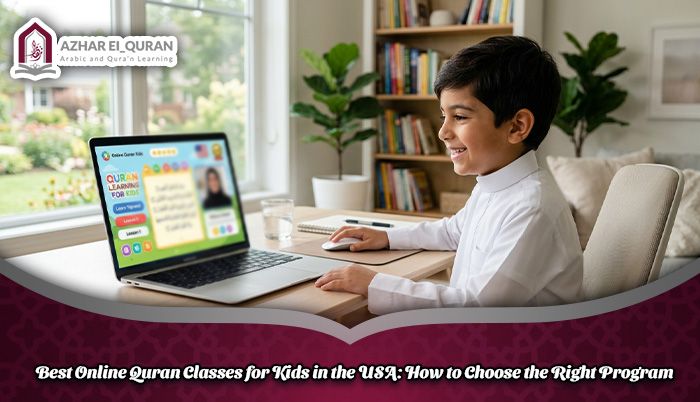
Best online Quran classes for kids in the USA include Azhar El-Quran Academy, which offers personalized live instruction. It is also known for free trial classes and experienced teachers.
Programs typically cover Quran recitation, Tajweed, Hifz (memorization), Arabic reading foundations, and understanding Quranic Arabic.
This platform emphasizes interactive, child-friendly learning with flexible scheduling to accommodate family routines. The best choice depends on your child’s age, learning style, and goals—whether focused on pronunciation, memorization, or comprehension.
If you are raising Muslim children in America, you know the challenge. School runs until mid-afternoon, then come homework, sports, and errands. The nearest qualified Quran teacher may be an hour away, and weekend Islamic school, though valuable, often gives only a couple of hours a week, spread across a full classroom.
That is why online Quran classes for kids in the USA have become a practical, well-established option for American Muslim families. With a laptop or tablet and a stable internet connection, your child can learn Quran online with a qualified teacher, at a time that fits your family's routine, without leaving home.
But not every program is equal. Some are excellent, with certified teachers, structured curricula,s and real accountability. Others are little more than a video call with no plan behind it. This guide explains what children can learn, which class formats exist, what parents should expect to pay, and how to choose an academy you can trust. Throughout, we show how we approach each of these at Azhar El-Quran Academy, so you can hold us to the same standard we recommend you apply to everyone.
Why Choose Online Quran Classes for Kids in the USA?
Online Quran classes for kids in the USA offer convenient access to certified tutors and flexible schedules that fit American school schedules and time zones.
Online learning is not just a fallback for families without a local option. For many children, it is the better fit. Here is why.
Learn from home, on your schedule.
There is no commute, no rushing from school to the mosque, and no missed class because of traffic. Most academies offer flexible-schedule Quran classes for kids, including after-school slots, evenings, and weekends. A consistent 30-minute session at 4:30 p.m. is far easier to sustain than a weekly drive across town.
Access to qualified teachers
In a small town or a city with few Islamic institutions, finding a properly trained teacher can be difficult. Online, your child can learn from Ijazah-certified teachers, including graduates of institutions like Al-Azhar, no matter where you live. Location stops limiting quality.
At Azhar El-Quran Academy, our teachers are Ijazah-certified in recitation, trained at Al-Azhar University, and have 20 years of experience teaching children, and every teacher undergoes a vetting process e.g., interviews, tests, and background checks) before teaching a child. One-on-one attention
In a classroom of 15 or 20 children, a teacher cannot listen closely to each child's recitation. In one-on-one online Quran classes for kids, the teacher hears every word your child recites, corrects mistakes immediately, and adjusts the pace to your child. A slower learner is not left behind, and a fast learner is not held back.
Safe and supervised
Parents worry about who is talking to their children online, and rightly so. With online Quran classes, your child sits in a shared family space, and you can join or listen in at any time. Reputable academies build parental supervision into their policies and never require private, unsupervised contact.
What Age Should Kids Start? A Level-by-Level Guide
Children can begin learning the Quran at very different ages, and the right approach changes as they grow. The table below gives a general guide. Every child is different, so treat it as a starting point.
|
Age group |
Learning focus |
Recommended session length |
|
4–6 years |
Arabic letters, short surahs, basic duas |
20–30 minutes |
|
7–12 years |
Noorani Qaida, Tajweed foundations, memorization |
30–45 minutes |
|
Teens |
Fluent recitation, deeper Hifz, meaning and Tafseer |
45–60 minutes |
Ages 4–6: playful foundations
Very young children learn through repetition, songs, and visuals. Quran classes for 5-year-olds focus on recognizing Arabic letters, hearing correct sounds, and memorizing short surahs like Al-Fatihah and Al-Ikhlas. Sessions should be short, cheerful, and full of encouragement. At this age, love for the Quran matters more than speed.
Ages 7–12: the core learning years
Most Quran classes for kids ages 4 to 12 concentrate here, and this is often the ideal window to build reading fluency. Children typically complete Noorani Qaida, begin Tajweed rules, and start memorizing longer passages. Their attention spans and reading skills can support a steady, structured curriculum.
Teens: fluency, depth, and meaning
Online Quran classes for teens should respect their maturity. Teenagers often benefit from focused Hifz goals, refined Tajweed,d and an introduction to translation and Tafseer, so they understand what they recite. A flexible schedule matters most for this group, as school and activities increase.
New Muslim families and kids who don't speak Arabic
Many American families speak little or no Arabic at home, and this is completely normal. Quran classes for kids who don't speak Arabic should use English-speaking teachers, patient step-by-step instruction and, where helpful, transliteration in the early stages, with a gradual move to reading Arabic script. This support also suits children of reverts who are learning the Quran alongside their parents.
Core Courses Your Child Can Learn
Most quality academies follow a natural learning path: Qaida first, then Tajweed, then Hifz, with Arabic and Islamic studies woven in. Here is what each stage involves.
What we offer at Azhar El-Quran Academy
Noorani Qaida • Tajweed • Hifz • Arabic for kids • studies, duas and manners • Tafseer for teens
Noorani Qaida for Kids Online
Noorani Qaida is the foundation of Quran reading. It teaches the Arabic letters, their shapes, their vowel marks, ks and the correct points of articulation (Makharij), which is where each sound comes from in the mouth and throat. Children learn to connect letters into words, then into short phrases.
Online, a teacher uses a digital whiteboard to highlight letters and drill sounds in real time. Most children need somewhere between a few months and a year to complete Qaida, depending on age, practice frequency, and session length. Rushing this stage causes problems later, so a good teacher will not move on until your child reads confidently.
At Azhar El-Quran Academy, children move to the next Qaida lesson only after they can read the current one confidently.
Online Tajweed Classes for Kids In the USA
Tajweed is the set of rules for reciting the Quran correctly, covering how to pronounce each letter, how long to extend certain sounds, and when to pause. It preserves the recitation exactly as it was revealed.
In Tajweed classes for kids online, the teacher listens live and corrects errors as they happen: a letter pronounced from the wrong place, a vowel held too short, a rule missed. Good programs introduce rules gradually and tie each one to verses the child is already reading, so the rules feel practical rather than abstract. Learning Quran with Tajweed for children early prevents habits that are much harder to fix in later years.
Online Quran Memorization for Kids in the USA (Hifz Program)
Memorizing the Quran, whether a few short surahs or the entire book, is a serious commitment, and structure is what makes it achievable. A well-designed Hifz program for kids online includes:
• Daily targets: a small, realistic amount of new memorization (sabaq)
• Revision systems: recent revision (sabqi) and long-term revision (manzil), so nothing fades
• Progress tracking: clear records of what has been memorized and what needs review
• Parent involvement: a simple routine of listening to revision at home
Can kids memorize the Quran online? Yes, and many do successfully. Timelines vary widely by child and by the hours of daily practice, so be cautious of any academy that promises a fixed date for completion. Consistency, revision, and a supportive home routine matter far more than speed.
Our Hifz students at Azhar El-Quran Academy follow a daily plan of new memorization and revision.
Arabic and Islamic Studies for Kids in the USA
Reading the Quran is just one part of Islamic education. Many academies also offer online Arabic classes for kids, covering basic vocabulary, simple sentences, and common Quranic words. Alongside this, children can learn daily duas for kids, prayer basics, Islamic manners and basics for kids, and the stories of the Prophets. These lessons connect the Quran to everyday character and behavior, which is what parents ultimately hope for.
Quran Translation and Tafseer for Older Kids
For older children and teens, understanding the meaning deepens the connection to the text. Age-appropriate Quran translation and Tafseer lessons explain the context of key verses and their practical lessons, building understanding alongside recitation.
Class Formats: One-on-One vs Group
Choosing between private and group lessons is one of the biggest decisions you will make. Here is how they compare.
|
|
One-on-one |
Group |
|
Teacher attention |
Fully focused on your child |
Shared among students |
|
Pace |
Personalized |
Set by the group |
|
Cost |
Higher |
Lower |
|
Peer motivation |
None |
Strong |
|
Best for |
Hifz, shy children, tailored goals |
Beginners, social learners |
One-on-one online Quran classes for kids in the USA
A private Quran tutor for kids online is best for a personalized pace, children who are shy or easily distracted, and any serious Hifz journey. Since every minute of the lesson is dedicated to your child, progress is usually faster, and problems are caught early.
Group classes
Group Quran classes for kids are more affordable and add a social element. Children often stay motivated when they see friends learning alongside them. They suit beginners and younger children who thrive on interaction. Look for small groups, since a large group defeats the purpose of individual correction.
Female Quran teachers for girls and young children
Many families prefer a female Quran teacher for kids online, especially for online Quran classes for girls and younger children. Ask any academy about the availability of female teachers up front, and confirm that they hold the same qualifications as their male colleagues. Boys can, of course, learn from female teachers too, particularly at younger ages.
Weekend and after-school options
Whether your child needs weekend Quran classes for kids online or a short daily slot after school, choose a format that fits into your week without exhaustion. A sustainable schedule will always outperform an ambitious one that collapses after a month.
How Much Do Online Quran Classes Cost in the USA?
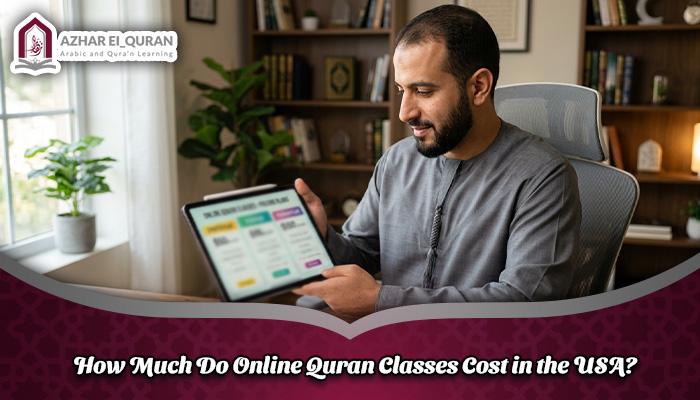
Prices vary considerably between academies, and there is no single standard rate. Before comparing, understand what drives the cost.
• Class type: one-on-one costs more than group
• Sessions per week: more frequent lessons cost more overall
• Teacher credentials: Ijazah-certified and highly experienced teachers often charge more
• Session length: 30 minutes versus 60 minutes
• Course type: Hifz programs usually require more time and commitment than basic reading
How to spot "too cheap " or hidden fees
Very low prices can signal inexperienced teachers, oversized groups,s or frequent cancellations. Ask directly: What is included? Are there registration or materials fees? What happens if a teacher is absent? Is there a refund policy? Transparent academies answer these questions without hesitation.
Free trial at Azhar El-Quran Academy
A good free trial class is not a sales pitch. Every new student at Azhar El-Quran Academy can book one with no obligation. During the trial, your child will:
• Meet a real teacher, not a sales representative
• Try the learning platform and digital whiteboard
• Receive a short level assessment
• Leave with a recommended learning plan for you to consider
If an academy pushes you to pay before the trial ends, treat it as a warning.
How to Choose the Best Online Quran Academy in the USA
With so many options, a checklist keeps your decision grounded. Use these eight criteria when comparing any online Quran academy for kids.
1. Teacher qualifications. Look for Ijazah in recitation, formal training, ng and, importantly, experience teaching children. A brilliant reciter is not automatically a good teacher for a six-year-old.
2. Structured curriculum. There should be clear levels, learning goals, and a defined path from Qaida to Tajweed to Hifz.
3. Progress reports. Regular updates or a student dashboard show exactly what your child has learned and what comes next.
4. Safety policies. Ask about parent access to sessions, teacher vetting and background checks, and how recordings are handled. Sessions should never be recorded or shared without your consent.
5. Technology. A reliable platform, whether Zoom or an in-house system, with clear audio and a digital whiteboard makes a real difference to learning quality.
6. US time-zone availability. Confirm there are teachers available in your time zone at the hours your child is free.
7. Trial, refund policy, and reviews. A trial class, a fair refund policy, and honest online Quran class reviews from real parents build confidence.
8. Teacher continuity. Children learn best with the same teacher each week. Frequent changes disrupt progress and trust.
Red flags to avoid: no trial offered, vague or unverifiable credentials, pressure to prepay for long packages, and reluctance to let parents observe.
Online Quran Classes vs Local Mosque or Weekend School
Parents often ask whether to choose online Quran classes vs local mosque classes or a weekend Islamic school. The truth is that each offers something different.
|
|
Online classesMosque/weekend |
d school |
|
Teacher attention |
High (especially one-on-one) |
Limited by class size |
|
Flexibility |
Very flexible |
Fixed schedule |
|
Community |
Limited |
Strong |
|
Commute |
None |
Required |
|
Pace |
Personalized |
Set by the class |
They are complementary rather than competing. The mosque offers community, friendships, and a sense of belonging, while online lessons provide focused individual correction and consistent progress. Many families combine the two, using online classes as an Islamic weekend school alternative or supplement during the week.
How to Keep Your Child Engaged in Online Quran Lessons
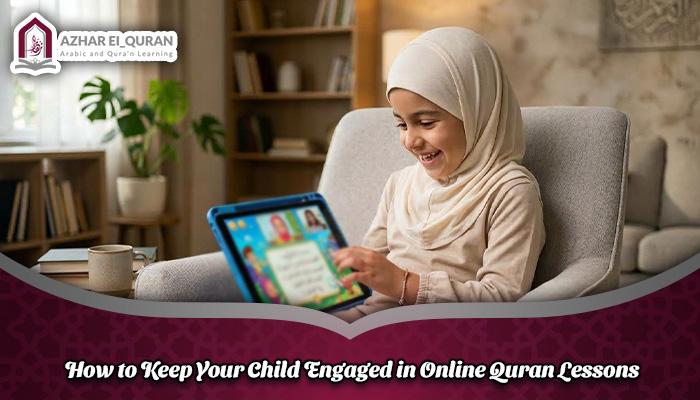
Even the best teacher cannot hold a distracted child's attention alone. A few simple habits help enormously.
• Set a fixed time and a quiet space. Routine tells your child that Quran class is as normal as dinner.
• Choose interactive tools. Digital whiteboards, games, and reward charts keep younger learners involved.
• Match session length to age. A 20-minute lesson that ends on a high note beats a 60-minute one that ends in tears.
• Stay involved. Sit in for the first few weeks, then listen to short revision at home. Review the progress reports together and celebrate small milestones.
Children who feel supported and encouraged keep going, and that consistency is what builds real fluency.
Class Times for US Families
Look for an academy that offers real coverage across US time zones: Eastern, Central, Mountain, and Pacific. Most families prefer after-school slots, early evenings,s or weekend mornings, so ask how many of these are actually open, not just advertised.
Azhar El-Quran Academy serves Muslim families across the United States, with English-speaking Quran teachers who understand American school schedules.
Frequently Asked Questions
What is the best age to start Quran classes for kids?
Many children begin around age 4 to 6 with letters and short surahs, but there is no strict cutoff. Starting early builds familiarity, while older children often progress faster once they begin. The best age is when your child can sit, listen, and enjoy the lesson.
Are online Quran classes effective for kids?
Yes, when the program is well structured. Live one-on-one sessions give immediate correction, personalized pacing, and consistent practice. Effectiveness depends on teacher quality, regular attendance, and support from parents at home.
Can kids memorize the Quran online?
Absolutely. Many children complete Hifz online with the help of daily targets, revision systems, and progress tracking. Timelines differ from child to child, so focus on steady routine rather than speed.
How long does it take a child to learn to read the Quran online?
It depends on age, session frequency,y and practice. Completing Noorani Qaida often takes several months to a year, followed by regular practice reading the Quran itself with Tajweed. Consistency matters more than the calendar.
Do online Quran classes offer a free trial?
Many reputable academies do. A good trial includes a real lesson with a teacher, a short level assessment, and a recommended plan, with no obligation to continue. Azhar El-Quran Academy offers a free trial class.
Are online Quran teachers qualified or certified (Ijazah)?
It varies by academy. Ask for teacher credentials directly, including Ijazah in recitation, formal training, and experience with children. A trustworthy academy will share these details openly.
How do I choose a good online Quran academy?
Compare teacher qualifications, curriculum structure, safety policies, technology, time-zone availability, trial classes, and parent reviews. Use the checklist earlier in this guide to compare your options side by side.
Why choose Azhar El-Quran Academy for my child?
Azhar El-Quran Academy offers one-on-one classes with certified teachers, a structured path from Qaida to Tajweed and Hifz, parent-visible sessions, and a free trial. The best way to judge is to book a trial and see how your child responds.
Conclusion
The right online Quran program combines qualified teachers, a clear curriculum, and a safe, encouraging environment. Whether your child is starting with their first Arabic letters or working toward memorization, the best online Quran classes for kids in the USA fit into your family's real life rather than adding stress to it.
Remember that every child progresses at their own pace. What matters most is steady practice, patient guidance, and a love for the Quran that grows over time. That is what we build at Azhar El-Quran Academy, and we would be honored to be part of your child's journey.
Book your child's free trial class with Azhar El-Quran Academy today.