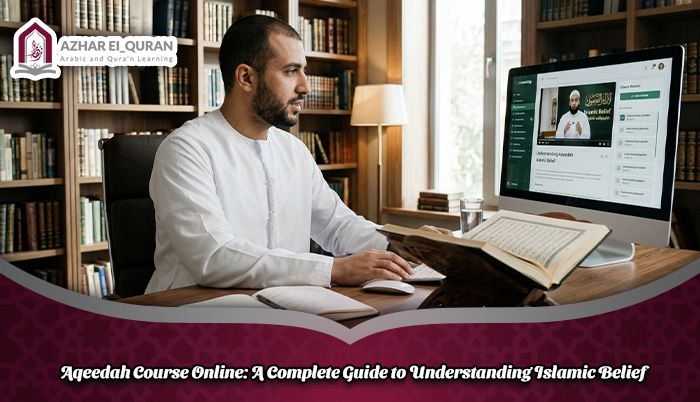
An Aqeedah course online provides structured Islamic theological education on core beliefs such as Tawheed, Allah's attributes, prophethood, and the Day of Judgment. These courses suit learners who want to deepen their understanding of Islamic creed in a flexible, accessible format.
Azhar El-Quran Academy offers an accredited Aqeedah course online from reputable scholars, often including video lectures, readings, and quizzes. Topics typically progress from foundational concepts to advanced discussions, ensuring clarity and authenticity. Such courses help strengthen faith, correct misconceptions, and foster a balanced worldview rooted in authentic Islamic teachings.
Every Muslim needs a clear understanding of what they believe and why they believe it. Islamic faith is not limited to performing daily prayers or following religious practices. It begins with knowing Allah, understanding His Oneness, believing in His messengers, and accepting the fundamental principles of Islam. This is why studying Aqeedah is essential for developing a strong and meaningful relationship with Allah.
An Aqeedah course online offers a convenient way to learn these essential beliefs through structured lessons and Islamic instruction. It is particularly valuable for Muslim families living in Western countries, new Muslims, and adults who want to strengthen their religious knowledge but may not have access to suitable local classes.
Whether you are starting your Islamic learning journey or revisiting the foundations of your faith, online Aqeedah classes can help you build a stronger understanding of Islam.
This guide explores what Aqeedah means, what you can learn, who can benefit, and how to choose a suitable online course.
What Is Aqeedah in Islam?
Aqeedah, also written as Aqidah, is an Arabic term that refers to a firm belief or conviction. In Islam, it describes the fundamental beliefs that a Muslim accepts with certainty. These beliefs form the foundation of Islamic faith and influence how Muslims understand their relationship with Allah, their purpose in life, and their responsibilities.
Islamic Aqeedah addresses some of the most important questions about human existence and the unseen. These include:
- Who is Allah, and what should Muslims believe about Him?
- Why did Allah create humanity?
- What is the purpose of our existence?
- What happens after death?
- What should Muslims believe about angels, revelation, and the Hereafter?
The answers to these questions are established through the Quran and the authentic Sunnah of Prophet Muhammad ﷺ. These two primary sources provide guidance about Allah, His attributes, the unseen world, and the principles of Islamic faith.
Aqeedah is sometimes described as Islamic creed or Islamic doctrine. It is not simply theoretical knowledge. It shapes a Muslim's understanding of worship, morality, responsibility, and everyday decisions.
For example, believing that Allah is All-Knowing encourages Muslims to remain conscious of their actions, whether they are alone or among others. Similarly, believing in the Day of Judgment reminds believers that their choices have consequences.
Studying Aqeedah helps Muslims understand the foundations of their religion rather than relying only on inherited knowledge or general information.
Why Is Learning Aqeedah Important for Every Muslim?
Learning Aqeedah is important because Islamic beliefs provide the foundation for every aspect of a Muslim's religious life. Before developing detailed knowledge of different Islamic practices, Muslims should understand the essential principles of faith and the reasons behind their worship.
One major benefit of studying Aqeedah is strengthening Iman. When Muslims understand who Allah is and recognize His greatness, mercy, wisdom, and power, they can develop a deeper appreciation of their relationship with Him.
Here are several important benefits of learning Islamic Aqeedah:
1. Strengthening the relationship with Allah
Understanding Allah's Names and Attributes helps Muslims recognize His greatness and develop love, gratitude, hope, and trust in Him.
2. Developing a deeper understanding of Tawheed
Tawheed is the foundation of Islamic belief. Studying it helps Muslims understand that Allah alone deserves worship and that nothing is equal to Him.
3. Building confidence in Islamic beliefs
A sound understanding of Islamic teachings helps believers explain their faith and approach religious questions with knowledge rather than confusion.
4. Understanding the purpose of worship
Aqeedah helps Muslims recognize that acts of worship are expressions of faith, obedience, gratitude, and devotion to Allah.
5. Developing a stronger Muslim identity
For Muslims growing up in multicultural societies, understanding Islamic beliefs can help them maintain a meaningful connection with their religion while participating positively in wider society.
6. Learning how to approach questions about faith
Muslims may encounter questions about creation, destiny, suffering, death, and the unseen. Studying Aqeedah provides a foundation for understanding these subjects through authentic Islamic teachings.
Ultimately, learning Aqeedah is a lifelong process that supports spiritual development and encourages Muslims to practise their religion with greater understanding.
What Will You Learn in an Aqeedah Course Online?
An online Islamic beliefs course introduces students to the essential principles of Islamic faith through organized lessons. The exact syllabus depends on the course level, teaching approach, and curriculum. However, a comprehensive Islamic creed course generally covers the Six Pillars of Iman and the fundamental concepts connected to them.
Students who learn Aqeedah online can gradually develop an understanding of Allah, the angels, divine books, prophets and messengers, the Hereafter, and divine decree.
Here are the main subjects commonly included in Aqeedah lessons for beginners.
Introduction to Aqeedah and the Fundamentals of Islamic Faith
A basic Aqeedah course usually begins by explaining the meaning of Iman and its relationship with Islam. Students learn what it means to believe in Allah and accept the essential teachings brought by Prophet Muhammad ﷺ.
They also explore the difference between the outward practices of Islam and the beliefs held in the heart. This introduction provides a foundation for understanding more detailed Islamic concepts in later lessons.
Belief in Allah (Tawheed)
Tawheed means affirming the Oneness of Allah. It is the central principle of Islamic monotheism and teaches that Allah is the Creator, Sustainer, and only One worthy of worship.
Students explore the concepts commonly discussed under Tawheed Ar-Rububiyyah, Tawheed Al-Uluhiyyah, and Tawheed Al-Asma wa Sifat. They learn about Allah's unique Names and Attributes and why Muslims must worship Him alone.
This part of an Islamic Aqeedah course also helps students understand that Allah has no partner, equal, or rival. His perfection is unlike anything in creation.
Belief in Angels and Divine Books
Muslims believe that angels are real creations of Allah who carry out the responsibilities assigned to them. An Aqeedah course introduces important angels and their roles according to authentic Islamic teachings.
Students also learn about the divine books revealed to different messengers. These include the Tawrah, Zabur, Injil, and the Quran. Particular attention is given to the Quran as the final revelation sent to Prophet Muhammad ﷺ and the primary source of guidance for Muslims.
Belief in Prophets and Messengers
Belief in all the prophets and messengers of Allah is an essential pillar of Iman. Students learn that Allah sent messengers to guide humanity towards worshipping Him and following His commands.
Lessons introduce important prophets, including Adam, Nuh, Ibrahim, Musa, and Isa (peace be upon them). They also explain the special position of Prophet Muhammad ﷺ as the final messenger.
Understanding Prophethood helps students appreciate the continuity of Allah's guidance throughout human history.
Belief in the Day of Judgment and the Hereafter
Islam teaches that worldly life is temporary and that every person will eventually return to Allah. An online Aqeedah course introduces students to the major beliefs concerning death, resurrection, accountability, Paradise (Jannah), and Hellfire (Jahannam).
Students learn that the Day of Judgment is a central part of Islamic faith and that people will be held accountable for their deeds.
These lessons encourage Muslims to live responsibly, perform good actions, avoid wrongdoing, and prepare for the Hereafter.
Belief in Divine Decree (Qadar)
Qadar refers to divine decree and is another essential pillar of Iman. Muslims believe that Allah has complete knowledge of everything and that nothing occurs outside His knowledge and decree.
Students explore the relationship between Allah's knowledge, His decree, human choices, and personal responsibility. They also learn about placing their trust in Allah while making sincere efforts and taking responsibility for their actions.
This subject helps Muslims understand that believing in destiny does not mean abandoning effort or personal responsibility.
A structured Aqeedah curriculum should explain these concepts carefully, using accessible language and appropriate references. Where Islamic scholars have different interpretations or terminology, students should be introduced to the relevant scholarly context rather than assuming that every formulation is universally agreed upon.
Who Should Enroll in an Aqeedah Course Online?
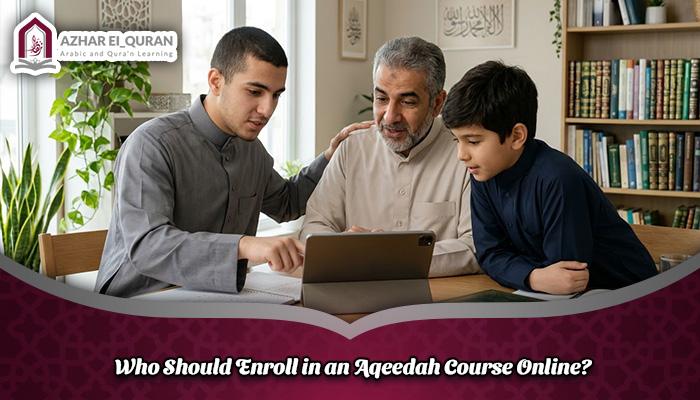
An Aqeedah course online can benefit Muslims at different stages of their religious learning journey. It is not designed only for advanced students or people with extensive Islamic knowledge. Many courses introduce the subject from the beginning, making it accessible to adults, children, and new Muslims.
Beginners Who Want to Understand Islamic Beliefs
People with limited Islamic knowledge can benefit from beginner-friendly Aqeedah lessons. These classes explain basic Islamic beliefs using simple language and familiar examples. Students do not need advanced knowledge of Arabic or Islamic theology to begin understanding the foundations of their faith.
Muslim Adults Seeking Deeper Religious Knowledge
Adults who want to revisit their religious foundations can use an Aqeedah course online for adults to strengthen their understanding of Islam. Whether they are balancing work, family, or other responsibilities, organized lessons can help them study essential beliefs consistently and develop stronger Iman.
Parents Looking for Islamic Aqeedah Classes for Kids
Muslim parents have an important responsibility to help their children understand their religion. Online Aqeedah classes for kids introduce Islamic beliefs through age-appropriate explanations and examples.
Children can learn about Allah, the prophets, angels, and the Hereafter in a way that matches their understanding. These lessons can also help parents establish a positive environment for discussing Islamic beliefs at home.
New Muslims and Reverts to Islam
New Muslims often have many questions about Islamic beliefs, worship, and religious practices. An Aqeedah course online for reverts can provide a structured starting point for understanding the foundations of Islam.
Beginner-friendly instruction, clear English explanations, and opportunities to ask questions are particularly valuable. A welcoming learning environment allows new Muslims to develop their knowledge gradually without feeling overwhelmed.
Muslims Living in Western Countries
Muslims living in the USA, UK, Canada, and Australia may find it challenging to access suitable local Islamic educational programs. Work commitments, school schedules, geographical distance, and language differences can create additional barriers.
Online Islamic classes make it possible to study Aqeedah from home and connect with teachers regardless of location. This flexibility can be particularly helpful for families who want consistent Islamic education for themselves and their children.
What Are the Benefits of Learning Aqeedah Online?
Online Islamic education has made foundational religious knowledge more accessible to Muslims around the world. Instead of depending entirely on nearby educational institutions, students can explore online Aqeedah classes that suit their schedules, learning levels, and educational needs.
Some important benefits include:
Flexible Learning Schedules
One of the main advantages of online Aqeedah lessons is scheduling flexibility. Students can look for classes that fit around work, school, family responsibilities, and other commitments.
This is particularly useful for Muslims living in different international time zones. A suitable schedule can make it easier to maintain regular Islamic studies without disrupting daily responsibilities.
Personalized Attention from Teachers
One-to-one Islamic classes can provide students with more opportunities to ask questions and receive explanations according to their knowledge level.
Personalized instruction is especially useful when studying complex subjects such as Tawheed, Qadar, and the beliefs concerning the unseen. Students can take time to understand important concepts before progressing to more advanced material.
Learning from Anywhere in the World
Online Islamic learning allows students to access lessons from home, whether they live in the United States, the United Kingdom, Canada, Australia, or elsewhere.
This can be especially valuable for non-Arabic speakers and Muslim families who have limited access to local Islamic education.
A Comfortable Environment for Asking Questions
A supportive learning environment encourages students to discuss questions about Islamic beliefs without feeling embarrassed.
Interactive Aqeedah lessons can help beginners clarify misunderstandings, review important concepts, and develop a more confident understanding of their faith.
However, online learning is most effective when students remain consistent, review their lessons, and seek clarification from knowledgeable teachers whenever necessary.

How to Choose the Best Aqeedah Course Online
Choosing the best online Aqeedah course requires more than comparing prices or lesson schedules. Students should consider the curriculum, teachers, teaching methods, language, and overall learning environment.
The following factors can help you make an informed decision.
Check the Teachers' Islamic Knowledge and Qualifications
Aqeedah is a foundational Islamic subject, so it is important to learn from knowledgeable and responsible teachers.
Look for instructors with relevant Islamic education, a sound understanding of the subject, and the ability to explain religious concepts accurately. Teaching experience also matters because complex ideas need to be presented in a clear and accessible way.
Do not hesitate to ask about a teacher's educational background and experience before enrolling.
Review the Course Curriculum
A well-organized Aqeedah course should follow a clear learning path. Check whether the curriculum introduces the foundations of Islamic belief before moving towards more detailed subjects.
Ideally, the course should cover the Six Pillars of Iman, Tawheed, the role of revelation, Prophethood, the Hereafter, and Qadar.
A clear syllabus helps students understand what they will study and whether the program matches their learning goals.
Look for English-Language Instruction
For Muslims who do not speak Arabic fluently, an Aqeedah course in English can make Islamic learning considerably easier.
Important Arabic terms should be introduced with their meanings and explanations. This helps students become familiar with Islamic terminology while understanding the concepts behind it.
Clear English instruction is particularly important for reverts, children growing up in Western countries, and adults who want to strengthen their religious knowledge.
Consider Teaching Methods and Student Support
Different students learn in different ways. Some prefer interactive discussions, while others benefit from structured explanations and regular revision.
Before choosing a course, consider whether students can ask questions, receive feedback, and review difficult topics. Personalized guidance can make a significant difference when studying Islamic beliefs.
Check Scheduling and Trial Lesson Options
A suitable course should fit your daily routine. Check available lesson times and whether the teaching schedule accommodates your local time zone.
You can also ask the academy whether it offers an introductory or trial lesson. This provides an opportunity to understand the teaching approach before making a commitment.
Taking time to compare these factors can help you select an Islamic creed course that supports consistent and meaningful learning.
Learn Islamic Aqeedah with Azhar El-Quran Academy
Developing a strong understanding of Islamic beliefs requires reliable educational guidance and a structured approach to learning. Azhar El-Quran Academy provides an online Islamic education platform for students interested in developing their religious knowledge from home.
For learners considering an Aqeedah course online, exploring the academy's educational programs can be a useful starting point. A structured learning pathway can help students progress from foundational Islamic beliefs to a deeper understanding of important subjects.
English-language explanations are particularly valuable for Western Muslims and non-Arabic speakers who want to understand Islamic teachings without facing unnecessary language barriers.
When exploring your learning options, consider discussing your current knowledge level, educational goals, preferred teaching approach, and scheduling requirements with the academy. You can also ask about the availability of Aqeedah-specific lessons, the curriculum, teacher qualifications, and suitable learning pathways for children, adults, and beginners.
Personalized educational guidance can help students identify an appropriate starting point and understand how to progress.
Explore Azhar El-Quran Academy's Islamic education programs and contact the academy to ask about its Aqeedah learning options. Take the first step towards understanding your faith with greater clarity and confidence.
Read Also:-
How to Pray Salah Step by Step
Islamic Studies Classes Online
How to Start Learning Aqeedah Online: A Step-by-Step Guide
Starting your Islamic learning journey does not need to be complicated. With a clear goal and a suitable study plan, you can gradually develop a better understanding of Islamic beliefs.
1. Identify Your Current Knowledge Level
Begin by considering what you already know about Islamic beliefs. Are you completely new to Aqeedah, or do you want to revisit the Six Pillars of Iman and study them in greater detail? Understanding your starting point will help you choose an appropriate course.
2. Choose a Suitable Course and Teacher
Look for an online Aqeedah course that matches your knowledge, age, and learning goals. Review the curriculum, ask about the teacher's background, and make sure the lessons are understandable and well organized.
3. Create a Consistent Learning Schedule
Set aside regular time for your online Aqeedah lessons. Review previous topics, write down important points, and ask questions whenever something is unclear. Consistency is more valuable than rushing through multiple subjects without understanding them.
Most importantly, try to apply what you learn in your daily life. Islamic knowledge should encourage reflection, stronger faith, and better religious practice.
Frequently Asked Questions About Aqeedah Courses Online
What Is an Aqeedah Course?
An Aqeedah course is an Islamic educational program that teaches the fundamental beliefs of Islam. It covers subjects such as Tawheed, belief in Allah, angels, divine books, prophets, the Hereafter, and divine decree. Its main purpose is to help Muslims understand the foundations of their faith through authentic Islamic teachings.
Can Beginners Learn Aqeedah Online?
Yes. Beginners can learn Aqeedah online through structured lessons that introduce Islamic beliefs gradually. A beginner-friendly course explains essential concepts using simple language before moving towards more detailed subjects. Students do not need advanced Islamic knowledge to start learning the foundations of their faith.
Is an Online Aqeedah Course Suitable for Children?
Yes. Online Aqeedah classes for kids can introduce children to basic Islamic beliefs through age-appropriate explanations. Lessons may cover who Allah is, the prophets, angels, and the Hereafter. Parents should choose educational programs that present these subjects in a clear, engaging, and suitable manner.
Can New Muslims and Reverts Study Aqeedah?
Absolutely. An Aqeedah course online for reverts can help new Muslims understand the essential beliefs of Islam and develop a strong foundation for their religious journey. Beginner-friendly lessons in English can make learning easier, especially when students have opportunities to ask questions and receive patient explanations.
Can I Learn Aqeedah in English Without Knowing Arabic?
Yes. You can study the fundamental principles of Islamic Aqeedah in English without being fluent in Arabic. Many important Islamic concepts can be explained through English-language instruction, while Arabic terms are introduced gradually with their meanings. Learning basic terminology can also improve your understanding of Islamic books and teachings over time.
How Long Does It Take to Complete an Aqeedah Course Online?
The duration of an Aqeedah course depends on its curriculum, lesson frequency, and the student's learning pace. An introductory program may cover the essential beliefs in a relatively short period, while more detailed courses require additional study and revision. Consistent learning and proper understanding should be more important than completing lessons quickly.
What Is the Difference Between Aqeedah and Fiqh?
Aqeedah and Fiqh are two important branches of Islamic knowledge, but they focus on different areas.
Aqeedah concerns the fundamental beliefs of Islam, including belief in Allah, His messengers, the angels, and the Hereafter. Fiqh focuses on practical Islamic rulings and religious responsibilities, such as prayer, fasting, zakah, and other acts of worship.
In simple terms, Aqeedah explains what Muslims believe, while Fiqh addresses how Muslims practise their religion.
Start Your Journey Toward Stronger Islamic Knowledge
Understanding Islamic beliefs is an essential part of developing a meaningful relationship with Allah. Rather than relying only on inherited knowledge or general information, every Muslim should make an effort to study the foundations of their faith through authentic Islamic teachings.
An Aqeedah course online provides a practical opportunity to build this understanding through structured lessons and guided learning. Whether you are a beginner, parent, adult learner, or new Muslim, taking the first step can make a meaningful difference in your Islamic education.
Explore the Islamic education programs offered by Azhar El-Quran Academy and contact the academy to learn about suitable Aqeedah learning options. Begin your journey towards stronger Iman and a deeper understanding of Islam today.