Islamic fiqh refers to the human understanding and interpretation of Islamic law derived from the Quran, Hadith, and other sources. It encompasses legal rulings on worship, transactions, family matters, and ethics, adapting to diverse cultural and historical contexts.
Fiqh differs from Sharia, considered divine law, because it involves scholarly reasoning (ijtihad) and varies across schools of thought (e.g., Hanafi, Maliki, Shafi'i, Hanbali). Modern challenges like digital finance and bioethics have prompted renewed efforts in fiqh to address contemporary issues while remaining grounded in classical principles.
Key principles of Islamic fiqh include the Quran as the primary authority, Sunnah (prophetic traditions), consensus (ijma), and analogical reasoning (qiyas).
Additional methods include juristic preference (istihsan), public interest (maslaha), and textual interpretation (tafsir). Fiqh applies Sharia contextually while maintaining adherence to divine revelation. These principles help scholars address new issues using established methodologies, preserving unity and adaptability in Islamic law.
Islamic Fiqh gives Muslims a practical understanding of how to live according to Islamic teachings. It explains the rules related to worship, family life, personal conduct, financial matters, and many everyday situations. For beginners, learning these rules with a knowledgeable teacher can make religious practice easier and more confidence-inspiring.
Whether you are a new Muslim, a parent looking for Islamic education for your child, or an adult who wants to strengthen your knowledge, an online Islamic Fiqh course can provide a flexible solution. You can study from home, ask questions during live lessons, and learn at a pace that matches your level.
This complete guide explains what Islamic Fiqh is, why it matters, what you can study, and how to choose a trustworthy online academy. It also explains the basic principles of Islamic jurisprudence and how they relate to the Quran and Sunnah.
With the right teacher and a structured curriculum, you can learn Islamic Fiqh in a clear, practical, and respectful way.
What Is Islamic Fiqh?
Islamic Fiqh refers to the human understanding and application of Islamic rulings based on recognized sources of Islamic law. The word fiqh is commonly translated as understanding or jurisprudence. In simple terms, Fiqh helps Muslims understand how Islamic teachings apply to real-life situations.
So, what is Fiqh in Islam? It is the study of practical rulings derived from the Quran, Sunnah, scholarly reasoning, and established principles of Islamic jurisprudence. It covers matters of worship as well as many aspects of personal and social life.
A beginner does not need an academic background to study Fiqh. A good course starts with the basics and gradually introduces more detailed subjects. This makes Islamic Fiqh accessible to children, adults, new Muslims, and Muslims who want to refresh their knowledge.
The principles of Islamic Fiqh also help students understand why scholars reach certain rulings. Instead of simply memorizing rules, students can learn the foundations behind them.
A structured introduction may include:
- Purification and cleanliness
- Salah and its conditions
- Fasting and Sawm
- Zakat
- Hajj and Umrah
- Halal and Haram
- Family and personal matters
- Basic Islamic ethics
- Common everyday questions
Studying Fiqh in Islam is therefore not only about memorizing information. It is about developing a practical understanding of how Muslims worship Allah and live according to Islamic guidance.

Importance of Learning Islamic Fiqh
Learning Islamic Fiqh is important because Muslims need reliable knowledge to practice their religion correctly. Worship is not simply about having good intentions. Muslims also need to understand the conditions, obligations, recommended actions, and things that may invalidate an act of worship.
For example, someone may know that Salah is obligatory but still have questions about purification, prayer times, clothing, intention, or what to do when a mistake occurs. Studying Fiqh provides a structured way to understand these matters.
The fiqh and its principles also teach students how Islamic rulings are understood from their recognized sources. This can help protect learners from relying on random social media posts or unverified online answers.
For Muslims in the West, structured learning can be especially useful. Parents may want their children to understand their faith while attending mainstream schools. Adults may want to study after work. New Muslims may need a simple introduction without being overwhelmed by advanced terminology.
Learning Islamic Fiqh can help you:
- Improve your worship.
- Understand everyday Islamic rules.
- Ask better questions.
- Recognize reliable Islamic guidance.
- Build confidence in religious practice.
- Teach basic Islamic knowledge to your family.
The goal is not to make every student a faqīh or Islamic scholar. Rather, the goal is to give ordinary Muslims the knowledge they need for their daily religious responsibilities.
A strong Islamic Fiqh program should therefore combine authentic knowledge with clear explanations and practical examples.
The Main Topics Covered in Islamic Fiqh Classes
A well-designed Islamic Fiqh course should take students from basic concepts to practical applications. Curricula may differ between schools and academies, but beginner courses usually focus on topics Muslims encounter regularly.
One of the first areas is Taharah, or purification. Students may learn about Wudu, Ghusl, cleanliness, impurities, and the conditions required for valid worship. These lessons create an important foundation for Salah.
Salah is another major area. Students can learn prayer conditions, obligatory acts, Sunnah practices, common mistakes, and situations that affect the validity of prayer.
Fasting is also an important part of Fiqh. Beginners may study the basic rules of Ramadan, what breaks the fast, who may be excused from fasting, and how missed fasts are handled.
More advanced courses may introduce subjects such as Zakat, Hajj, marriage, divorce, business transactions, inheritance, dietary rules, and other areas of Islamic law.
The principles Islamic Fiqh students encounter can include concepts related to obligations, recommendations, prohibitions, permissions, evidence, intentions, necessity, hardship, and benefit.
A quality academy should explain these topics according to a recognized scholarly methodology rather than presenting isolated opinions without context.
For beginners, the best approach is usually progressive. Students should first understand essential rules before moving into areas that require deeper study.
This is one reason Islamic Fiqh classes can be valuable for both children and adults. A teacher can adjust the explanation to the student's age, knowledge, and learning goals.
Understanding the Five Main Rulings in Islamic Fiqh
One of the Islamic Fiqh principles beginners often encounter is the classification of actions according to their legal ruling. Learning these categories makes it easier to understand Islamic rules.
The five commonly taught rulings are:
- Wajib or Fard: An obligatory action that Muslims are required to perform.
- Mandub or Mustahabb: A recommended action that is rewarded but not obligatory.
- Mubah: An action that is generally permissible.
- Makruh: An action that is disliked, though not normally prohibited.
- Haram: An action that is prohibited.
These categories provide a basic framework for understanding Fiqh in Islam. For example, Salah is obligatory, while many additional acts of worship are recommended. Certain foods or actions may be prohibited, while ordinary permissible activities fall under Mubah.
However, beginners should avoid assuming that every Islamic question can be answered simply by placing it into one category. Context, evidence, intention, circumstances, and scholarly interpretation can all matter.
This is where studying with a qualified teacher becomes useful. A teacher can explain the principles of Islamic Fiqh and show students how rulings are understood instead of encouraging them to make independent legal judgments.
The purpose of learning these classifications is practical. Students can begin to understand the difference between something they must do, something they should ideally do, something they may do, and something they should avoid.
A strong Islamic Fiqh course teaches these concepts gradually, using examples that beginners can understand.
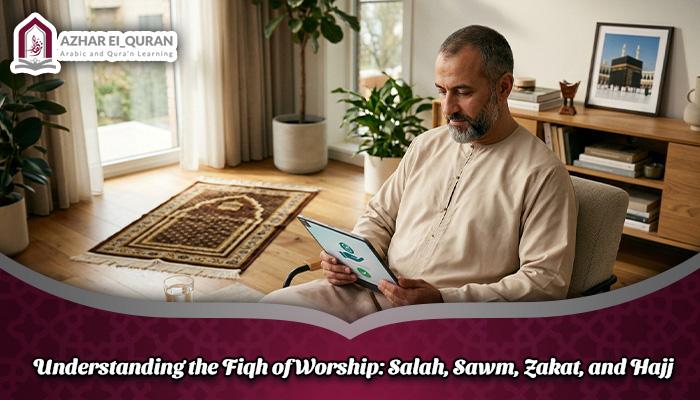
Understanding the Fiqh of Worship: Salah, Sawm, Zakat, and Hajj
The Fiqh of worship is one of the most important areas for every Muslim. It focuses on acts of worship and the rules that help Muslims perform them correctly.
Salah is central to Muslim life. Fiqh lessons can explain purification, prayer times, the direction of prayer, intention, essential actions, and common mistakes. Beginners can also learn what to do when they miss a prayer or make a mistake during Salah.
Sawm, especially fasting during Ramadan, is another major topic. Students can learn the fiqh of fasting: who must fast, what invalidates the fast, legitimate exemptions, and how missed fasts are addressed.
Zakat introduces Muslims to the principles of obligatory charity. Depending on the student's level, a course may explain eligibility, wealth thresholds, calculation, and eligible recipients.
Hajj covers the pilgrimage to Makkah. Students can learn its basic obligations, essential actions, restrictions, and practical preparation.
Studying these topics through Islamic Fiqh gives worship a stronger foundation. Instead of relying only on what someone has heard from family members or online discussions, students can study the rules systematically.
For children, teachers can use age-appropriate examples. For adults and new Muslims, lessons can focus on practical situations they are likely to encounter.
The aim is not to make worship complicated. Good Fiqh teaching should make essential knowledge clearer and help students practice Islam with confidence and sincerity.
Learn Islamic Fiqh Through the Quran and Sunnah
The Quran and Sunnah are central to understanding Islamic Fiqh. A responsible Fiqh course should teach students how Islamic rulings are connected to authentic sources and recognized methods of interpretation.
The Quran provides foundational guidance on belief, worship, morality, family life, financial matters, and many other areas. The Sunnah provides further explanation and practical examples from the life and teachings of Prophet Muhammad ﷺ.
The principles of Islamic fiqh help scholars understand and apply evidence. These principles include methods for interpreting texts, reconciling evidence, understanding general and specific statements, and dealing with different circumstances.
Students do not need to become specialists in Usul al-Fiqh to benefit from this knowledge. Even a basic understanding can help them appreciate why qualified scholarship matters.
This is especially important online. Muslims can find thousands of opinions with a few searches. Some may be reliable, while others may lack context or scholarly support.
A reputable platform for Islamic jurisprudence should therefore emphasize qualified instruction rather than encouraging students to collect isolated answers from the internet.
At Azhar El-Quran Academy, learners can study Islamic subjects in an organized online environment with teachers who can explain concepts at an appropriate level. The academy can be a useful choice for Western Muslims who want accessible Islamic education without having to travel to a local institution.
When studying Islamic Fiqh, students should learn to respect legitimate differences among scholars and understand that not every disagreement means that one side is acting without evidence.
Online Islamic Fiqh Classes for Beginners, Adults, and Children
Online Islamic Fiqh classes offer flexibility for families who may not have a suitable Islamic learning center nearby. This can be particularly helpful for Muslims living in the US, UK, Canada, Australia, and other Western countries.
Parents can arrange lessons around school schedules. Adults can study after work or during a convenient weekend time. New Muslims can receive beginner-friendly instruction without feeling embarrassed about asking basic questions.
Children also benefit from lessons designed for their age. A young student should not be taught in the same way as an adult. Good teachers use simple explanations, examples, questions, and repetition to make lessons meaningful.
Online learning can also remove geographical barriers. Students can connect with qualified instructors from home rather than spending time commuting to a physical classroom.
A typical online Islamic Fiqh lesson may include:
- A short review of the previous lesson.
- Explanation of a new concept.
- Quran and Sunnah references where appropriate.
- Practical examples.
- Questions and answers.
- Homework or revision.
- Feedback from the teacher.
One-to-one classes can be particularly useful because the teacher can adapt the pace to the learner. Small-group lessons may also work well for families or students who enjoy learning with others.
For beginners, consistency is more important than rushing through a large amount of material. Regular Islamic Fiqh study can gradually build a strong foundation.
The right course should make learning manageable, practical, and connected to everyday Muslim life.

Learn Islamic Fiqh with Expert Teachers
A qualified teacher can make a major difference when learning Islamic Fiqh. Fiqh contains technical terms, scholarly discussions, and differences of opinion that can be difficult for beginners to navigate alone.
An experienced teacher can explain difficult concepts in simple English while preserving the accuracy of the subject. They can also distinguish between established fundamentals and issues where scholars have legitimate differences.
This is particularly important for Western Muslims. Students may come from different cultural backgrounds and may have questions shaped by the environment in which they live.
At Azhar El-Quran Academy, learners can access structured online Islamic education designed for students at different levels. As a leading online learning platform, the academy can connect students with teachers who understand the importance of clear instruction, respectful communication, and consistent learning.
When selecting a teacher, consider whether the instructor:
- Has appropriate Islamic education and teaching experience.
- Can explain concepts clearly.
- Welcomes questions from beginners.
- Uses reliable sources.
- Understands the student's age and learning level.
- Respects recognized scholarly differences.
- Provides a structured curriculum.
The teacher's role is not simply to provide answers. A strong teacher helps students develop a foundation for understanding Fiqh responsibly.
Students should also remember that online lessons are educational. Personal legal questions involving complex circumstances may require consultation with a qualified scholar who can assess the specific situation.
With appropriate instruction, Islamic Fiqh becomes easier to understand and apply.
How to Choose the Best Islamic Fiqh Course Online
Choosing an online Islamic Fiqh course requires more than selecting the first academy that appears in search results. The quality of the teacher, curriculum, learning method, and support can make a significant difference.
First, check whether the course is designed for your level. A beginner needs a clear introduction to the basics of Islamic Fiqh, not a highly technical academic program.
Second, look at the curriculum. A good course should explain what students will learn and how the lessons progress.
Third, consider the teacher's qualifications and experience. Islamic education requires responsible instruction, particularly when discussing religious rulings.
Fourth, consider flexibility. Western Muslim families may need evening or weekend classes because of school, work, and family commitments.
You should also ask whether the academy offers:
- Live online lessons
- One-to-one or small-group options
- Classes for children and adults
- Beginner-level courses
- Qualified male and female teachers
- Flexible scheduling
- Trial lessons
- Regular student feedback
- Clear communication with parents
Azhar El-Quran Academy is a strong option for learners seeking an online Islamic education platform that combines structured teaching with the convenience of remote learning.
Some people searching online may use unusual phrases such as “learn academy fishy” when looking for an Islamic learning academy. Rather than focusing on imperfect search wording, students should focus on the quality, credibility, curriculum, and teaching standards of the institution they choose.
A useful Islamic Fiqh course should also encourage students to ask questions. If an academy simply gives unexplained answers without teaching the underlying principles, the learning experience may remain limited.
The best course is one that helps you build a lasting understanding rather than simply memorize isolated rules.
Frequently Asked Questions About Islamic Fiqh
What is Islamic Fiqh?
Islamic Fiqh is the study and understanding of practical Islamic rulings based on recognized sources and principles. It helps Muslims understand how Islamic teachings apply to worship and everyday matters.
Why should beginners learn Islamic Fiqh?
Beginners can learn Islamic Fiqh to understand essential rules related to Salah, fasting, purification, Zakat, Hajj, and daily life. Structured lessons also help students avoid relying on unreliable or incomplete information.
Can I learn Islamic Fiqh online?
Yes, students can learn Islamic Fiqh online through live classes with qualified teachers. Online learning allows beginners, adults, children, and Western Muslim families to study from home at convenient times.
How do I choose a good Islamic Fiqh course?
Look for a course with qualified teachers, a clear curriculum, reliable sources, beginner-friendly lessons, and flexible scheduling. A free trial lesson can also help you assess whether the teaching style is suitable for you or your child.
Start Learning Islamic Fiqh Online Today
Understanding Islamic Fiqh gives Muslims practical knowledge for worship and everyday life. Whether you are a beginner, a parent, a new Muslim, or an adult seeking stronger Islamic knowledge, the right course can make learning much easier.
You do not need to master everything at once. Start with the basics, study consistently, ask questions, and build your knowledge step by step.
Azhar El-Quran Academy provides an accessible online environment for students who want to learn Islamic subjects from home with qualified teachers. With flexible lessons and structured instruction, you can make Islamic learning part of your routine.
Ready to strengthen your understanding of Fiqh? Book a free trial lesson with a native Arabic teacher/tutor at Azhar El-Quran Academy and take the first step toward learning Islamic Fiqh with confidence.