Noon Sakinah and Tanween are essential in proper recitation and pronunciation, especially in Quranic Arabic, where they affect the flow and rhythm of speech. Noon Sakinah may also trigger Ikhfa (concealment) or Idgham (merging) in Tajweed rules.
Noon Sakinah refers to the letter 'ن' (noon) without a vowel sign, producing a soft nasal sound at the end of a word. Tanween is a diacritical mark (ً ٍ ٌ) added to nun (ن) to indicate a nasalized vowel sound, commonly used in Arabic grammar to denote grammatical cases like nominative, accusative, or genitive.
Have you ever listened to a reciter and wondered why some words carry a soft, humming sound through the nose, while others are crisp and clear? In most cases, you are hearing Noon Sakinah and Tanween at work. These two topics make up one of the most important chapters of tajweed, and they appear on almost every page of the Quran.
The good news is that the whole subject comes down to just four rules: Izhar, Idgham, Iqlab, and Ikhfa. By the end of this guide, you will be able to spot each rule, say it correctly, and know why it sounds the way it does. Every Arabic example comes with a transliteration, so no prior knowledge is needed. This guide is written for beginners, new Muslims (reverts), and parents helping their children, and it follows the way we teach at Azhar El-Quran Academy.
In this guide: What is Noon Sakinah and Tanween· The difference · The 4 rules at a glance · Izhar · Idgham · Iqlab · Ikhfa · Quick-reference chart · Common mistakes · How to practice · Kids and reverts.
What Is Noon Sakinah? (Definition and Examples)
Noon Sakinah (نْ) is a noon letter with sukoon, meaning it has no vowel of its own. It is a real, written letter; it stays in the word even when you stop reading, and its pronunciation changes depending on the letter that follows it.
You may also see it spelled noon saakin (النون الساكنة). Both mean the same thing.
Meaning of "Sakinah" in Tajweed
In Arabic, sakinah (or saakin) means "still" or "without movement." A letter with a sukoon has no fatha, kasra, or damma. So a noon sakinah is simply a noon that "rests" rather than moves. Because it does not carry a vowel, the reciter has to decide how to handle it as they move into the next letter. That decision is exactly what the four rules answer.
Where Noon Sakinah Appears in a Word
Noon sakinah can appear in the middle or at the end of a word, and it can be found in nouns, verbs, and particles. Here are three examples:
|
Arabic |
Transliteration |
Position |
|---|---|---|
|
مِنْ |
min |
End of a word |
|
مَنْ |
man |
End of a word |
|
أَنْعَمْتَ |
an'amta |
Middle of a word |
A helpful point to remember: the four rules apply when the noon sakinah is followed by one of the 28 Arabic letters. The following letter determines which rule you use.
What Is Tanween? (The Three Types)
Tanween is an extra "n" sound added to the end of a noun. It is shown by doubling the short vowel mark, and it is pronounced but never written as a separate letter.
Fathatan, Kasratan and Dammatan
There are three forms of tanween, each matching one of the short vowels:
|
Type |
Arabic |
Sound |
Example |
|---|---|---|---|
|
Fathatan |
ـً |
-an |
كِتَابًا (kitaaban) |
|
Kasratan |
ـٍ |
-in |
كِتَابٍ (kitaabin) |
|
Dammatan |
ـٌ |
-un |
كِتَابٌ (kitaabun) |
Tanween appears only at the end of nouns and adjectives. It never appears at the beginning or middle of a word, and it is never found on verbs.
Why Tanween Behaves Like a Hidden Noon
When you hear tanween, you are really hearing a tiny noon sound at the end of the word: kitaabun ends with an "n." That is why scholars of tajweed treat it exactly like a noon sakinah. The sound is there, but the letter is not written. Once you understand this, you will realize that you are not learning two different topics. You are learning one set of rules that applies to both.
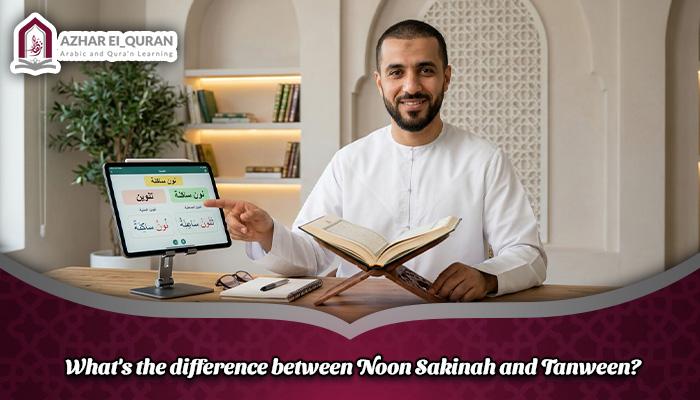
What's the difference between Noon Sakinah and Tanween
The two share the same sound and the same four rules, but they are not identical. Here is a side-by-side view:
|
|
Noon Sakinah |
Tanween |
|---|---|---|
|
Written as a letter? |
Yes (ن) |
No, shown by a doubled vowel mark |
|
Where it appears |
Middle or end of a word |
End of a word only |
|
Found in |
Nouns, verbs and particles |
Nouns and adjectives only |
|
When you stop reading |
Stays and is pronounced |
Disappears (you stop on the plain vowel sound) |
|
Rules that apply |
Izhar, Idgham, Iqlab, Ikhfa |
Izhar, Idgham, Iqlab, Ikhfa |
There is one small difference in how the rules work. Idgham (merging) only happens between two separate words. This matters for noon sakinah, because it can sit inside a word, and we will cover that exception below.
The 4 Rules of Noon Sakinah and Tanween at a Glance
Before going into detail, here is the full map. Keep this table in mind as you read.
|
Rule |
Meaning |
Letters |
Ghunnah? |
|---|---|---|---|
|
Izhar |
Clear pronunciation |
ء هـ ع ح غ خ (6 letters) |
No |
|
Idgham |
Merging |
ي ر م ل و ن (6 letters) |
With ghunnah for ي ن م و; without for ل ر |
|
Iqlab |
Conversion |
ب (1 letter) |
Yes |
|
Ikhfa |
Concealment |
15 letters |
Yes |
That is 6 + 6 + 1 + 15 = 28 letters, the entire Arabic alphabet. This is why the rules are complete: every letter that can follow a noon sakinah or tanween belongs to exactly one rule.
Ghunnah (غنّة) is the soft nasal sound produced from the nose, held for about two counts (roughly the length of two quick beats). You will see it come up again and again.
Rule 1: Izhar (Clear Pronunciation)
Izhar means "to make clear." When noon sakinah or tanween is followed by one of the throat letters, you pronounce the noon clearly and fully, with no nasal blending and no ghunnah.
The 6 Throat Letters (ء هـ ع ح غ خ)
These letters are produced from the throat (their makharij, or exit points). That is why the rule exists: noon comes from the tongue and the nose area, while these letters come from deep in the throat. They are so far apart that the sounds cannot blend, so the noon stays clean.
In English, the letters are: hamza, haa, 'ayn, haa (heavy), ghayn, khaa.
Examples from the Quran
|
Arabic |
Transliteration |
Letter |
Reference |
|---|---|---|---|
|
مَنْ آمَنَ |
man aamana |
ء |
Al-Baqarah 2:62 |
|
مِنْ هَادٍ |
min haadin |
هـ |
Ar-Ra'd 13:33 |
|
أَنْعَمْتَ |
an'amta |
ع |
Al-Fatiha 1:7 |
|
عَلِيمٌ حَكِيمٌ |
'aleemun hakeem |
ح |
Tanween example |
Notice that in the last example, the tanween (-un) is followed by a throat letter, so the "n" sound is clear.
How to Pronounce Izhar Correctly
Say the noon sound cleanly and move on to the throat letter. Don't hum through your nose and don't stretch it. Think of it as a short, tidy "n," almost like a full stop before the next letter begins.
Rule 2: Idgham (Merging)
Idgham means "to merge." The noon sakinah or tanween blends into the letter that follows it, so the noon sound disappears and the next letter is pronounced as if it carried a shaddah (doubling).
The 6 Letters of Idgham (ي ر م ل و ن)
A classic memory aid is the word يَرْمَلُونَ (yarmaloon), which contains all six letters: yaa, raa, meem, laam, waw, noon. It is divided into two groups:
Idgham with Ghunnah (ي ن م و)
With these four letters, the noon merges into the next letter, but you keep the nasal sound for about two counts.
|
Arabic |
Transliteration |
Letter |
Reference |
|---|---|---|---|
|
مَنْ يَقُولُ |
may-yaqool |
ي |
Al-Baqarah 2:8 |
|
مِنْ وَالٍ |
miw-waal |
و |
Ar-Ra'd 13:11 |
|
يَوْمَئِذٍ نَاعِمَةٌ |
yawma'idhin-naa'imah |
ن |
Al-Ghashiyah 88:8 |
In the first example, you do not say "man yaqool" with a clear noon. You merge it into the yaa and hold the nasal sound, so it sounds like "may-yaqool."
Idgham without Ghunnah (ل ر)
With laam and raa, the noon disappears completely, with no nasal sound at all.
|
Arabic |
Transliteration |
Letter |
Reference |
|---|---|---|---|
|
مِنْ رَبِّهِمْ |
mir-rabbihim |
ر |
Al-Baqarah 2:5 |
|
هُدًى لِلْمُتَّقِينَ |
hudal-lilmuttaqeen |
ل |
Al-Baqarah 2:2 |
The Exception: Same-Word Idgham
The rule of Idgham only applies when the noon sakinah and the next letter are in two different words. If both are in the same word, the noon stays clear (Izhar). This happens in only four words in the Quran:
- دُنْيَا (dunyaa)
- صِنْوَانٌ (sinwaan)
- قِنْوَانٌ (qinwaan)
- بُنْيَانٌ (bunyaan)
The reason is practical: if the noon merged, the word could be mistaken for another word. So the noon stays clear to protect the meaning. Scholars call this Izhar Mutlaq.
Rule 3: Iqlab (Conversion)
Iqlab means "to turn over" or "to convert." It is the shortest rule because it only has one letter.
The One Letter of Iqlab (ب)
Whenever a noon sakinah or tanween is followed by the letter baa (ب), Iqlab applies.
How the Sound Changes
The noon is converted into a hidden meem sound, and you pronounce it with ghunnah for about two counts. In the Quran, you will see a small meem (مـ) written above the noon to remind you of the change.
|
Arabic |
Transliteration |
Reference |
|---|---|---|
|
مِنْ بَعْدِ |
mim-ba'di |
Al-Baqarah 2:27 |
|
سَمِيعًا بَصِيرًا |
samee'am-baseera |
An-Nisa 4:58 |
|
أَنْبِئُونِي |
am-bi'ooni |
Al-Baqarah 2:31 |
The last example shows that Iqlab also applies when the noon and baa are in the same word.
Lip Position Tip
Close your lips lightly, as if you were about to say a gentle "m," and let the nasal sound flow through the nose for two counts. Then release into the baa. Don't press the lips tightly and don't open them too soon.
Rule 4: Ikhfa (Concealment)
Ikhfa means "to hide." The noon is neither fully clear nor fully merged. Instead, it is concealed with ghunnah, held for about two counts, as the tongue moves toward the position of the next letter.
The 15 Letters of Ikhfa
Ikhfa applies to the remaining 15 letters:
ت ث ج د ذ ز س ش ص ض ط ظ ف ق ك
In English: taa, thaa, jeem, daal, dhaal, zay, seen, sheen, saad, daad, taa (heavy), dhaa (heavy), faa, qaaf, kaaf.
To memorize them, many students use the first words of a famous line of poetry from the classical tajweed text, which contains all 15 letters in order:
Examples with Transliteration
|
Arabic |
Transliteration |
Letter |
Reference |
|---|---|---|---|
|
مِنْ قَبْلُ |
min qabl (with hidden noon) |
ق |
Al-Baqarah 2:4 |
|
أَنْتُمْ |
an-tum (with hidden noon) |
ت |
Common word |
|
قَوْلًا سَدِيدًا |
qawlan sadeedaa |
س |
Al-Ahzab 33:70 |
Why Ikhfa Is the Hardest Rule for Beginners
Ikhfa sits in the middle. It is not the clear noon of Izhar, and it is not the full merge of Idgham. Most beginners either pronounce a clear noon or skip the nasal sound altogether.
Here is a simple tongue-position tip: do not let the tip of your tongue touch the roof of your mouth (where it would normally touch for a clear "n"). Hold it just short of the position of the next letter, let the sound resonate in the nose for two counts, and then release into the letter. The closer the next letter is to the noon in the mouth, the more the noon is hidden; the farther away, the lighter the concealment.
.jpg.jpeg "Noon Sakinah and Tanween Rules Chart (Quick Reference)")
Noon Sakinah and Tanween Rules Chart (Quick Reference)
Bookmark this chart for quick review while you read the Quran:
|
Rule |
Letters |
Ghunnah |
Example |
|---|---|---|---|
|
Izhar |
ء هـ ع ح غ خ |
No |
مِنْ هَادٍ (min haadin) |
|
Idgham with ghunnah |
ي ن م و |
Yes |
مَنْ يَقُولُ (may-yaqool) |
|
Idgham without ghunnah |
ل ر |
No |
مِنْ رَبِّهِمْ (mir-rabbihim) |
|
Iqlab |
ب |
Yes |
مِنْ بَعْدِ (mim-ba'di) |
|
Ikhfa |
ت ث ج د ذ ز س ش ص ض ط ظ ف ق ك |
Yes |
مِنْ قَبْلُ (min qabl) |
Want a printable version? Download our free one-page Noon Sakinah and Tanween chart (PDF) by entering your email address. (Visit Azhar El-Quran Academy.)
READ MORE
Common Mistakes Students Make with Noon Sakinah and Tanween
Even motivated students tend to fall into the same traps. Watch out for these:
- Over-nasalizing Izhar. Adding a hum when the noon should be clear and clean, especially before throat letters.
- Skipping the ghunnah in Idgham. With ي ن م و, the nasal sound must be present. Dropping it changes the recitation.
- Adding ghunnah to Idgham with ل and ر. The opposite error: these two letters merge without any nasal sound.
- Pronouncing Iqlab as a clear noon. Saying "min ba'di" instead of "mim-ba'di" is one of the most common slips.
- Confusing Ikhfa with Izhar. Pronouncing a full clear noon where it should be hidden.
- Holding ghunnah too long or too short. Two counts are the guide.
The challenge is that you often cannot hear your own mistakes. This is where one-to-one correction matters. At Azhar El-Quran Academy, our tutors listen to your recitation live, flag the exact word, and have you repeat it until it sounds right.
How to Practice Noon Sakinah and Tanween Effectively
Practice with Short Surahs
Start small. Short surahs you may already know are perfect for spotting the rules:
- Al-Fatiha: أَنْعَمْتَ (an'amta) is a clear example of Izhar.
- Al-Ikhlas: كُفُوًا أَحَدٌ (kufuwan ahad) shows Izhar with tanween before a hamza.
- Al-Asr: خُسْرٍ إِلَّا (khusrin illaa) is another Izhar with tanween.
Take one surah at a time, underline every noon sakinah and tanween, and name the rule before you recite.
Listen, Repeat, Record
Listen to a qualified reciter, repeat a single verse, then record yourself and compare. Pay close attention to the length of the ghunnah and the lip position in Iqlab. Colour-coded tajweed Qurans can also help you see the rules at a glance.
Why Live Feedback from a Tutor Matters
Apps and videos are useful, but they cannot hear you. A qualified teacher catches errors you cannot, corrects your mouth position, and explains why a sound is wrong. Even 20 minutes of focused, live feedback can accomplish more than hours of self-study. That is the heart of how we teach at Azhar El-Quran Academy.

Teaching Tajweed to Kids and New Muslims
For parents: Keep Tajweed lessons short and playful. Turn the four rules into a game: have your child raise a hand when they hear a hum. Start with Izhar (the easiest) and add one rule at a time, and praise effort over perfection.
For reverts and adult beginners: Don't feel pressured to master everything at once. Learn the Arabic letters and their exit points first, and then add the rules gradually. Many reverts find that tajweed actually makes reading easier once the patterns click. Be patient with yourself. Everyone started where you are.
Whether you are a parent in Toronto or a new Muslim in Manchester, you do not need to figure it out alone. Our Quran classes for kids and beginner tajweed course are designed for learners at every level.
Frequently Asked Questions
How many rules does noon sakinah have?
Noon sakinah has four rules: Izhar (clear pronunciation), Idgham (merging), Iqlab (conversion), and Ikhfa (concealment). The same four rules apply to tanween. Together they cover all 28 Arabic letters, so every letter that follows a noon sakinah or tanween falls under exactly one rule.
What is the difference between noon sakinah and tanween?
Noon sakinah is a written noon with a sukoon and can appear in the middle or end of a word. Tanween is a doubled vowel mark at the end of a noun, pronounced as a hidden "n" but never written as a letter. They sound alike and follow the same four rules.
What are the letters of Izhar, Idgham, Iqlab, and Ikhfa?
Izhar: ء هـ ع ح غ خ. Idgham: ي ر م ل و ن. Iqlab: ب only. Ikhfa: ت ث ج د ذ ز س ش ص ض ط ظ ف ق ك. That makes 6, 6, 1, and 15 letters respectively, adding up to all 28 letters of the Arabic alphabet.
How long should ghunnah be held?
Ghunnah is held for about two counts (harakat), which is roughly the time it takes to say two quick beats. This applies to Idgham with ghunnah, Iqlab, and Ikhfa. Your tutor can help you train your ear so the length becomes natural rather than counted.
Can I learn tajweed online as a complete beginner?
Yes. Online learning works very well for beginners, especially with live one-to-one lessons where the teacher listens to your recitation and corrects it in real time. You only need a stable internet connection and a quiet space. Many of our students started with no Arabic reading experience at all.
Learn Tajweed with Azhar El-Quran Academy
To recap: Izhar keeps the noon clear before throat letters, Idgham merges it into yarmaloon, Iqlab turns it into a hidden meem before baa, and Ikhfa conceals it before the remaining 15 letters. Master these four, and your recitation will sound smoother and more accurate.
At Azhar El-Quran Academy, you learn with certified tutors in one-to-one live sessions, scheduled to suit your life across US, UK, Canadian, and Australian time zones. We welcome children, adults, and new Muslims at every level.
Ready to start? Book your free trial lesson today and hear the difference expert guidance makes.