Online Arabic classes for beginners focus on foundational skills such as mastering the Arabic alphabet, basic pronunciation, essential vocabulary, and simple grammar rules like verb conjugation. These courses are designed for adult learners and emphasize interactive, self-paced learning from home.
Azhar El-Quran Academy offers structured curricula that gradually build proficiency while incorporating cultural context. Online Arabic classes for beginners include audio-visual aids, practice exercises, and real-time instructor feedback to enhance comprehension and confidence in speaking and understanding Arabic.
Many beginners also struggle to find a tutor who can explain Arabic clearly while understanding the needs of Muslims living in the US, UK, Canada, or Australia.
Online Arabic classes for beginners make learning more accessible. You can study from home, choose a convenient lesson time, and learn with a teacher who understands your level and goals. Instead of trying to learn everything at once, you can build your skills one step at a time.
Arabic is also important for many Muslims because it is the language of the Quran. Learning Arabic can help you recognize Quranic words, understand common Islamic terms, and become more confident when reading the Quran. It can also open the door to everyday communication and a deeper appreciation of Arabic-speaking cultures.
For children and adults, online Arabic classes for beginners can provide a structured alternative to scattered videos, apps, and free resources. A good teacher can correct pronunciation, explain grammar, answer questions, and adjust lessons to the learner's pace.
Whether you are a complete beginner, a parent looking for Quran Arabic lessons for your child, a new Muslim, or an adult who wants to reconnect with the language of the Quran, the right course can give you a clear starting point.
What Are Online Arabic Classes for Beginners?
Online Arabic classes for beginners are structured lessons delivered online by an Arabic teacher or tutor. Students normally attend live lessons using a computer, tablet, or smartphone. Depending on the program, classes may be one-to-one or conducted in a small group.
The purpose is to help a new learner develop the basic skills needed to read, write, understand, and eventually speak Arabic. A well-designed Arabic for beginners course does not assume previous knowledge. It starts with fundamental concepts and gradually introduces more challenging material.
For many learners, live instruction is more useful than studying alone. An experienced teacher can hear how you pronounce a word and correct mistakes immediately. You can also ask questions when a grammar rule or sentence structure is unclear.
At Azhar El-Quran Academy, learners can study Arabic online through structured lessons designed around their individual level and learning needs. The academy provides access to experienced teachers and a learning environment suitable for both children and adults.
A typical beginner course may cover:
- Arabic letters and their different forms
- Basic reading and writing
- Vowels and pronunciation
- Common Arabic vocabulary
- Simple greetings and expressions
- Basic grammar
- Sentence formation
- Listening and speaking practice
- Quranic vocabulary for Muslim learners
The biggest advantage of online Arabic classes for beginners is the combination of convenience and personal guidance. You do not have to travel to a language institute or wait for a nearby class to open. You can study Arabic from home while following a clear learning plan.

What Will You Learn in Online Arabic Classes for Beginners?
A good beginner program should give you a strong foundation instead of rushing into advanced grammar. Online Arabic classes for beginners normally follow a gradual curriculum, allowing students to understand one skill before moving to the next.
At the beginning, you may learn how Arabic letters look and sound. You then practise joining letters to form words. Once reading becomes more comfortable, lessons can introduce vocabulary, sentence patterns, and basic grammar.
Arabic lessons for beginners can also be adapted according to the student's purpose. Someone learning Arabic for travel may focus on conversation. A Muslim interested in Islamic studies may spend more time on Quranic vocabulary. Parents may want lessons that combine Arabic reading with Islamic learning.
A complete beginner may work through topics such as:
- The Arabic alphabet
- Short and long vowels
- Letter connections
- Common nouns and verbs
- Personal pronouns
- Demonstrative words
- Question words
- Basic sentence structures
- Everyday expressions
- Simple conversations
With consistent practice, these lessons can prepare a learner for more advanced study. Some students eventually progress into a complete Arabic beginner-to-intermediate course, where they develop broader vocabulary and more complex grammar skills.
There are also many options for learning Arabic for beginners online for free, including educational websites, videos, apps, and downloadable worksheets. These resources can be useful for additional practice. However, free resources often do not provide individual correction or a personalized study plan.
For learners who want structured support, online Arabic classes for beginners with an expert tutor can make the learning process clearer and more consistent.
Learn the Arabic Alphabet and Letters Step by Step
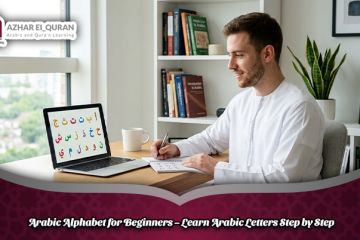
Learning the alphabet is one of the first milestones for beginners. Arabic has 28 letters, and several letters change their appearance depending on where they occur in a word. This can initially seem confusing to someone who has only used the Latin alphabet.
A well-planned program makes this easier by introducing the letters gradually. Online Arabic classes for beginners can give students time to recognize each letter, practise its sound, and understand how it connects with other letters.
Reading practice should not be rushed. Students need to become familiar with letter shapes before moving into longer words and sentences. Teachers can also demonstrate how certain Arabic sounds are produced because some sounds do not have exact equivalents in English.
For children, alphabet lessons can include colourful learning materials, repetition, games, and simple activities. Adults may prefer a more direct approach with reading exercises and written practice.
If you are a Muslim learner, mastering the Arabic alphabet can also support your Quran reading. Arabic literacy is an important foundation for anyone who wants to read the Quran more confidently.
Students using online Arabic classes for beginners can practise between lessons with worksheets, digital resources, flashcards, or Arabic learning apps. Regular short practice is often more manageable than trying to study for several hours once a week.
The important thing is consistency. Ten to fifteen minutes of focused practice each day can reinforce what was covered during a live lesson.
Learn Arabic Pronunciation with Expert Teachers
Pronunciation is an area where beginners often need personal guidance. Arabic contains sounds that may be unfamiliar to English speakers, so simply reading a written pronunciation guide is not always enough.
Online Arabic classes for beginners allow teachers to listen to students and identify specific pronunciation problems. The teacher can demonstrate a sound, explain how to produce it, and give the student opportunities to repeat it correctly.
This is especially useful for Muslim learners who want to learn Quran online and Arabic together. Accurate pronunciation matters when reading Arabic religious texts, and students can benefit from a teacher who understands both Arabic language instruction and Quranic reading.
A native Arabic teacher can also expose students to natural expressions and everyday vocabulary. Rather than memorizing isolated words, learners can hear how words are used in real sentences.
At Azhar El-Quran Academy, learners can learn Arabic online with expert teachers through lessons that focus on practical progress. Students can receive guidance suited to their age, ability, and learning objectives.
One-to-one teaching can be particularly valuable. Online one-to-one Arabic lessons give the teacher more time to focus on the student's individual mistakes and questions. A child who needs more repetition can receive it, while an adult who learns quickly can move ahead without waiting for the rest of a group.
Good pronunciation develops through listening, repetition, correction, and regular use. A qualified teacher can make each stage more effective.
Master Basic Arabic Grammar and Sentence Structure
Grammar does not have to be intimidating. For beginners, the goal is not to memorize hundreds of complicated rules. The goal is to understand how Arabic words work together to create meaning.
Online Arabic classes for beginners can introduce grammar through simple examples. Students may first learn how to identify nouns, verbs, and pronouns. They can then learn how basic sentences are formed and how words change according to context.
For example, beginners can learn the difference between nominal and verbal sentences at an appropriate level. They can also practise using common pronouns and question words in short conversations.
Arabic grammar becomes much easier when learners see it in context. Instead of studying a rule without examples, students can read a sentence, identify the structure, and then create a similar sentence themselves.
This approach is useful for anyone who wants to study the Arabic language for communication or Islamic learning. It also creates a foundation for later study of areas such as Nahw and Sarf, which are important parts of traditional Arabic grammar and morphology.
Students considering Arabic courses for beginners should therefore look for a curriculum that balances vocabulary, grammar, reading, listening, and speaking.
Online lessons also make it easier to revisit difficult topics. A teacher can explain the same concept using a different example if the first explanation does not make sense.
The objective is steady progress. Once learners understand basic sentence patterns, they can begin forming their own sentences rather than simply recognizing words.
Quranic Arabic for Beginners: Understand the Quran Better
For many Muslims, Arabic has a special purpose. It is the language in which the Quran was revealed, so learning Quranic Arabic can help students recognize important words and expressions while reading.
Online Arabic classes for beginners can introduce Quranic vocabulary alongside general Arabic foundations. Students may learn common words that appear frequently in the Quran and gradually understand how those words function within a sentence.
This does not mean that learning basic Arabic automatically makes someone qualified to interpret the Quran. Quranic interpretation requires appropriate scholarship and context. However, learning the language can help Muslims engage with the Arabic text more directly.
A beginner may start by learning frequently encountered words related to faith, worship, creation, guidance, mercy, prayer, and other familiar Islamic concepts. Over time, vocabulary knowledge can grow through repeated exposure.
For those who want to learn Quran online and Arabic, combining Quran lessons with Arabic study can provide a more connected learning experience. Students can improve their reading while also developing language skills.
Online Arabic lessons for beginners may also be useful for new Muslims who want to understand common Arabic phrases used in Salah and Islamic practice.
Some learners begin with free resources. Learning Arabic for beginners for free can be a helpful way to explore the language before committing to a structured course. However, learners who want regular feedback may benefit from working with an instructor.
The best approach depends on your goals. If you aim to understand Quranic vocabulary, look for a program that includes relevant Arabic content rather than only conversational material.
Online Arabic Classes for Kids and Adults
Arabic learning is not limited to one age group. Children, teenagers, university students, parents, and older adults can all benefit from structured Arabic instruction.
For children, online Arabic classes for beginners should be engaging and age-appropriate. Young learners may lose interest when lessons rely entirely on grammar explanations. Teachers can use repetition, stories, visual materials, questions, and interactive exercises to keep lessons active.
Parents may also want their children to develop Arabic alongside Islamic education. In this case, a program that connects Arabic with Quran reading and Islamic vocabulary can be particularly relevant.
Adults often have different needs. They may want to learn Arabic for Quran study, travel, communication, family connections, or personal development. Arabic lessons online for beginners allow adults to study without commuting to a physical classroom.
Another benefit is flexibility. A parent can arrange lessons around school and work schedules. An adult learner can choose a lesson time that fits around professional responsibilities.
There are many courses with Arabic available online, ranging from general language programs to specialized Quranic Arabic courses. Platforms such as Coursera and other educational resources may provide useful learning materials, while specialist academies may offer live instruction and individual support.
When comparing an online Arabic course for beginners, consider whether the course is genuinely designed for your age and goals.
A child may need a different teaching style from an adult. Likewise, a learner interested in Quranic Arabic may need different content from someone primarily interested in spoken Arabic.
Flexible Online Arabic Lessons for Busy Beginners
Finding time to learn a language can be one of the biggest challenges for adults and families. School schedules, work commitments, childcare, and other responsibilities can make traditional classroom attendance difficult.
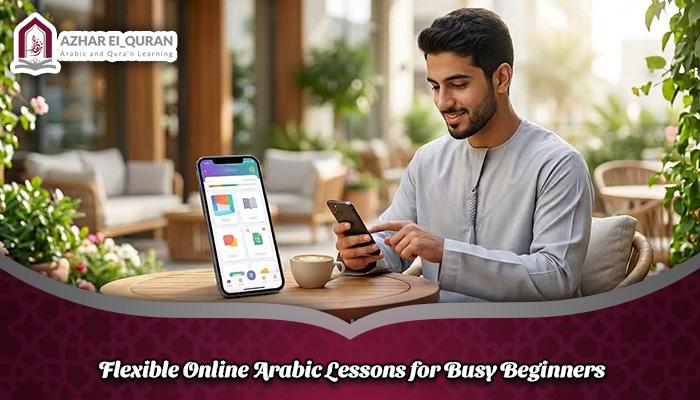
This is where online Arabic classes for beginners can offer practical flexibility. Students can attend lessons from home without spending time travelling to and from a language centre.
For families in the UK, US, Canada, and Australia, online learning can also make it easier to find teachers who understand their educational and cultural needs. Time-zone differences can be managed when academies provide flexible scheduling.
Online Arabic language learning also gives students access to resources that may not be available locally. Instead of limiting your options to teachers in your immediate area, you can choose from qualified instructors who teach remotely.
Learners can supplement their classes with:
- Arabic reading worksheets
- Vocabulary flashcards
- Listening exercises
- Educational videos
- Language-learning apps
- Quranic vocabulary resources
- Online dictionaries
- Teacher-provided homework
Apps and free websites can be helpful for revision. However, they work best when used alongside a clear learning plan.
If you search for Arabiconline, Madinah, Azhar, Mishkah, Rahman School, or other Arabic learning resources, you will find different approaches to language education. Each resource may serve a different purpose, so compare the curriculum, teacher support, lesson format, and learner level before enrolling.
The key benefit of online Arabic classes for beginners is that learning can fit around your life rather than requiring you to reorganize everything around a classroom.
How to Choose the Best Online Arabic Classes for Beginners
Choosing the right program requires more than searching for the cheapest course. The best online Arabic course for beginners should match your goals, current level, age, schedule, and preferred learning style.
Start by checking who teaches the Arabic for beginners course. Qualified and experienced teachers can make a significant difference, especially when students need help with pronunciation or grammar.
Next, look at the curriculum. Good online Arabic classes for beginners should have a logical progression. You should know what you will learn first, what comes next, and how your skills will develop over time.
Consider these factors before enrolling:
- Teacher quality: Look for experienced Arabic instructors who can communicate clearly.
- Lesson format: Decide whether one-to-one or group classes suit you better.
- Curriculum: Check whether reading, writing, speaking, vocabulary, and grammar are covered.
- Quranic focus: Muslim learners may prefer a course that includes Quranic Arabic.
- Flexibility: Check whether lesson times work with your local schedule.
- Age suitability: Children need different teaching methods from adults.
- Progress tracking: Regular feedback can help you identify areas that need more practice.
- Trial lessons: A trial can help you evaluate the teacher and learning environment.
Cost also matters. Some students begin by searching for learning Arabic for beginners online free or learning Arabic for beginners free. Free material can be useful for practice, but structured instruction may offer greater accountability and personalized feedback.
You should also avoid choosing a course simply because it uses words such as “academy,” “expert,” or “best.” Read the course details and understand exactly what is included.
At Azhar El-Quran Academy, beginners can receive structured Arabic instruction designed to make learning practical and accessible. The focus is on helping students develop useful skills while receiving guidance from experienced teachers.
Whether your goal is Quranic Arabic, everyday communication, Arabic reading, or broader language study, the right program should make your next step clear.
Frequently Asked Questions
What are the best online Arabic classes for beginners?
The right class depends on your learning goals, age, schedule, and preferred teaching style. Look for experienced teachers, a structured beginner curriculum, regular feedback, and flexible lesson times.
Can I learn Arabic online as a complete beginner?
Yes. Online Arabic classes for beginners can start with the alphabet, pronunciation, vocabulary, and basic sentence structures before progressing to more advanced topics. You do not need previous Arabic knowledge to begin.
Can I learn Quranic Arabic online?
Yes. Many online programs include Quranic vocabulary and Arabic structures that can support your Quran learning. Students should remember that understanding the language and interpreting the Quran are different skills.
Are online Arabic classes suitable for children?
Yes. Children can learn effectively online when lessons are age-appropriate and interactive. One-to-one instruction can also allow the teacher to adjust the pace and activities to the child's needs.
Conclusion
Learning Arabic does not have to feel overwhelming. With the right curriculum, consistent practice, and guidance from an experienced teacher, beginners can gradually build confidence in reading, pronunciation, vocabulary, grammar, and communication.
Online Arabic classes for beginners provide a convenient way for Muslims and families in the West to access structured Arabic education from home. Whether you are learning for the Quran, Islamic studies, everyday communication, or personal development, starting with strong foundations will make future learning easier.
Azhar El-Quran Academy can help you take that first step with experienced teachers and structured online lessons designed for beginners.
Ready to start learning Arabic? Book a free trial lesson with a native Arabic teacher/tutor and discover a simple, supportive way to learn Arabic online.