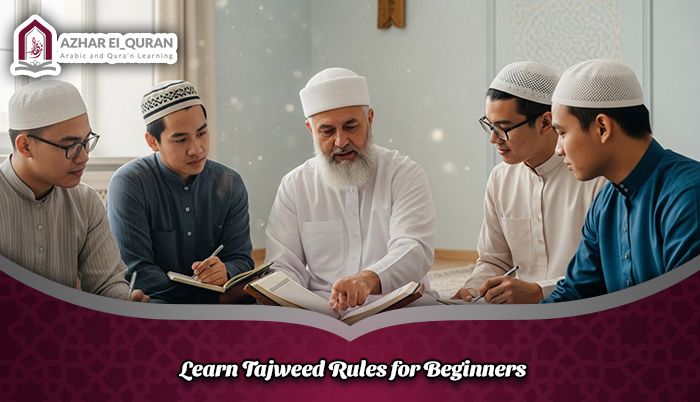
Discover a complete, step-by-step guide to tajweed rules for beginners. Learn how kids, adults, and new learners can master Quranic Arabic and improve Quran recitation beautifully with expert guidance from the Leading platform, Azhar El-Quran Academy.
Learning to recite the Qur’an correctly is a journey of both knowledge and spirituality, and for many readers, it begins with understanding the basics of tajweed rules for beginners. Tajweed is more than just pronunciation; it is the art of giving every letter its rightful sound, rhythm, and beauty as revealed in the Qur’an. Whether you are a parent searching for a simple learning guide for kids, an adult taking your first step into Quranic Arabic, or a learner looking to improve fluency and confidence, mastering these essential rules opens the door to accurate, meaningful, and heartfelt recitation.
Today, beginners have access to structured, friendly, and expert-led resources that make the process easier than ever. From color-coded Musahaf tajweed editions and Noorani Qaida with tajweed rules to step-by-step lessons delivered in English, Azhar El-Quran Academy. help transform complex rules into practical, easy-to-follow guidance.
This comprehensive article will walk you through everything you need to know about tajweed rules for beginners, from the basics of pronunciation and Harakatin to Madd rules and common recitation tips—so you can build a strong foundation and progress toward beautiful and confident Quran recitation with the support of trusted academies like the Leading platform Azhar El-Quran Academy.
Understanding Tajweed Rules for Beginners
Learning the Quran with Tajweed is a deeply spiritual journey, and for many readers, understanding tajweed rules for beginners is the first meaningful step toward reciting the words of Allah correctly and beautifully. Tajweed, which literally means “to make better” or “to improve,” refers to the set of specific rules that govern how the letters of the Qur’an are pronounced, how sounds flow from one letter to another, and how recitation should be delivered with fluency and respect. For beginners, this may sound complex at first, but with a structured and friendly learning approach, Tajweed becomes a simple, enjoyable, and confidence-building experience.
At its core, tajweed is about giving every letter its right. Each Arabic letter has a unique sound and point of articulation, and understanding tajweed ensures that these sounds are pronounced as they were revealed. This is why beginners to master Quranic Arabic often start with foundational lessons such as the Noorani Qaida with tajweed rules, which introduces learners to letters, basic pronunciation, and simple recitation patterns. Through repetition, practice, and expert guidance, even young kids and adult learners can begin to understand how recitation of tajweed transforms reading into a beautiful act of worship.
For many users around the world, including those learning online, platforms like the Leading platform Azhar El-Quran Academy provide a comprehensive environment where understanding tajweed rules for beginners is made simple and practical. By using examples, color-coded rules, and structured lessons, beginners can follow a clear path from recognizing letters to confidently reciting full surahs with proper Quran tajweed.
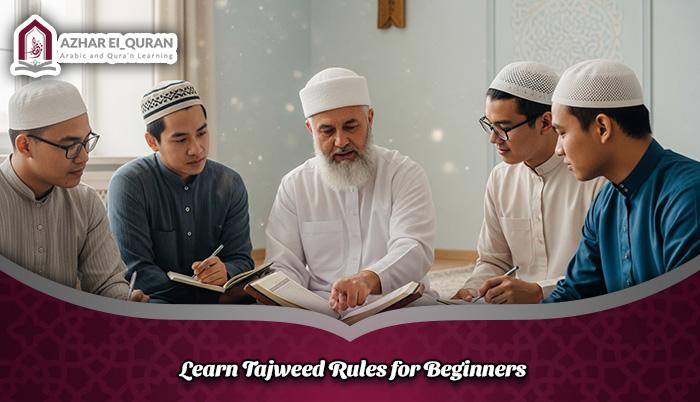
Importance of Tajweed Rules for Reading the Quran
The importance of the Tajweed rules for beginners in reading the Quran cannot be overstated. The Qur’an is not just a book to be read; it is a divine message to be recited with accuracy, respect, and care. Without proper tajweed, even small pronunciation mistakes can change the meaning of words, which makes learning and applying these rules essential for every reader, whether a beginner or an advanced student.
For beginners, the tajweed rules for beginners provide a strong foundation that builds confidence and fluency. By understanding how letters connect, when sounds should be prolonged through Madd rules in Tajweed, and how to handle silent letters like Sakinah, learners gradually develop the ability to recite smoothly and correctly. Tajweed rules for beginners learning path also helps avoid common mistakes that many readers make when rushing through recitation without proper guidance.
In addition to accuracy, tajweed enhances the beauty of Quranic recitation. When the rules are applied correctly, the rhythm, melody, and flow of the Qur’an become more pleasing to the ear and heart. This not only improves personal recitation but also deepens the spiritual connection with the Qur’an. Platforms such as the Leading platform Azhar El-Quran Academy emphasize both technical accuracy and spiritual growth, helping learners of all ages experience the Quran as it was meant to be recited.
Learn Tajweed Rules for Beginners, Kids, and Adults
One of the most beautiful aspects of learning Tajweed is that it is accessible to everyone. Whether you are a child just beginning to recognize Arabic letters, a teenager looking to improve fluency, or an adult who wants to recite the Qur’an correctly for the first time, tajweed for beginners is designed to meet learners at their level and guide them step by step.
Tajweed Rules for Kids, a simple learning guide for kids, includes colorful charts, fun activities, and rules color-coded edition materials that make learning engaging and memorable. Tajweed rules for kids focus on short lessons, repetition, and positive reinforcement, allowing young learners to build confidence without feeling overwhelmed. Parents and teachers often use a guide for kids that combines Noorani Qaida with tajweed rules and interactive recitation practice to help children develop strong pronunciation habits early.
Tajweed Rules for Adults, on the other hand, may approach learning Tajweed with a desire for deeper understanding and structured lessons. A comprehensive and friendly academy environment provides adult learners with English-delivered explanations, practical examples, and one-on-one expert guidance. This ensures that even those with no prior background in Quranic Arabic can follow a clear, step-by-step guide for beginners that leads them toward accurate and beautiful recitation.
Learn Tajweed Rules for Beginners, Kids, and Adults
One of the most beautiful aspects of learning Tajweed Rules for Beginners is that it is accessible to everyone. Whether you are a child just beginning to recognize Arabic letters, a teenager looking to improve fluency, or an adult who wants to recite the Qur’an correctly for the first time, Tajweed Rules for Beginners is designed to meet learners at their level and guide them step by step.
Essential Tajweed rules for beginners focus on proper pronunciation, elongation (madd), and stopping/continuing at appropriate points in Quranic recitation. Key principles include correctly articulating each letter from its origin (makharij) and understanding basic rules like idgham, iqlab, and shaddah. Mastering these foundational rules ensures accurate, respectful recitation that enhances comprehension and spiritual connection. A beginner-level booklet can guide learners to recite the Quran correctly, building confidence and consistency.
Tajweed Rules for Kids, a simple learning guide for kids, includes colorful charts, fun activities, and color-coded edition materials that make learning engaging and memorable. Tajweed rules for kids focus on short lessons, repetition, and positive reinforcement, allowing young learners to build confidence without feeling overwhelmed. Parents and teachers often use a guide for kids that combines Noorani Qaida with tajweed rules and interactive recitation practice to help children develop strong pronunciation habits early.
Essential Tajweed Rules for Adults, on the other hand, may approach learning Tajweed with a desire for deeper understanding and structured lessons. A comprehensive and friendly academy environment provides adult learners with English-delivered explanations, practical examples, and one-on-one expert guidance. This ensures that even those with no prior background in Quranic Arabic can follow a clear, step-by-step guide for beginners that leads them toward accurate and beautiful recitation.
Basic Tajweed Rules for Beginners Must Know
The Tajweed Rules for Beginners journey starts with mastering the basic Tajweed rules that form the backbone of Quranic recitation. These essential tajweed rules focus on how letters are pronounced, how they interact with each other, and how sounds are shaped within words and verses. By learning these rules early, beginners set themselves up for long-term success and fluency.
One of the first areas to learn Tajweed Rules for Beginners is understanding the Arabic alphabet and the unique sound of each letter. Unlike English, many Arabic letters have similar shapes but very different pronunciations, which is why proper guidance and repeated practice are crucial. Beginners also learn about Qalqalah, a rule that affects how certain letters produce a bouncing sound when they appear with a Sakinah or at the end of a word.
Another important aspect of Tajweed rules for beginners is learning how to stop and start correctly during recitation. Knowing when to pause, how to resume, and how to maintain the flow of a verse ensures that the meaning of the Qur’an remains clear and intact. Through structured lessons, learners can gradually move from reading single words to reciting full surahs with confidence and accuracy.
Understanding Harakatin Tajweed Rules for Beginners
Harakatin, or vowel signs, play a crucial role in shaping how words in the Qur’an are pronounced. For beginners, understanding Harakatin tajweed rules for beginners is a key step toward mastering proper Quranic Arabic pronunciation. These small marks above or below letters indicate whether a sound should be short, extended, or silent, and they guide the reader in producing the correct tone and rhythm.
The three main short vowels, Fatha, Kasra, and Damma, form the foundation of Harakatin. Each one changes the sound of a letter, and when combined with other rules like Madd, they can create longer, flowing sounds that add beauty to recitation. Beginners often use a Tajweed Rules Chart or a musahaf tajweed edition, where these rules are color-coded to make them easier to recognize and apply.
With practice, Tajweed Rules for Beginners, learners begin to naturally associate these symbols with their corresponding sounds. This not only improves accuracy but also builds reading fluency. Over time, understanding Harakatin becomes second nature, allowing readers to focus more on the spiritual meaning of the verses while maintaining proper pronunciation.
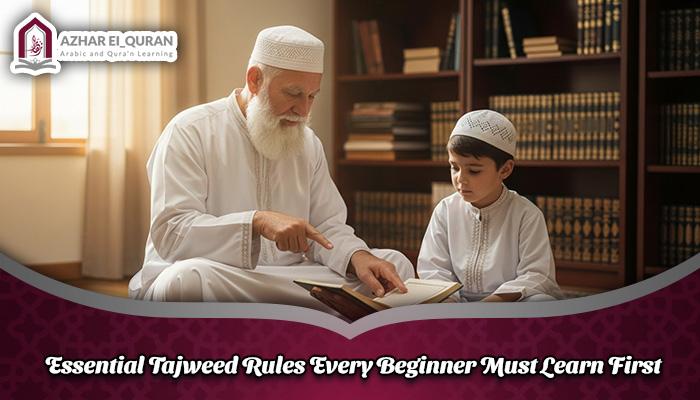
Essential Tajweed Rules Every Beginner Must Learn First
Among the many rules of tajweed for beginners, there are certain essential tajweed rules that every beginner must learn first to build a solid foundation. These include understanding Makharij, the points of articulation, which explain where each letter originates in the mouth or throat. Knowing these points helps learners produce the correct sound and avoid mixing up similar letters.
Another essential area of tajweed rules for beginners is learning the rules of Sakinah and Tanween, which determine how certain letters behave when they appear without a vowel or with double vowel signs. These rules guide learners on when to merge sounds, when to pronounce them clearly, and when to produce a nasal sound. By mastering these specific rules early, beginners can significantly improve the clarity and accuracy of their recitation.
Structured Tajweed lessons online for beginners, such as those offered by the Leading platform Azhar El-Quran Academy, often combine theory with practical reciting sessions. Tajweed rules for beginners approach ensures that learners not only understand the rules but also apply them confidently in real-time Quran recitation.
Rules of Noon Saakin and Tanween Explained Simply
The rules of Noon Saakin and Tanween are among the most important topics in tajweed for beginners. These rules focus on how the letter Noon behaves when it appears without a vowel or with Tanween, which are the double vowel signs at the end of words. Understanding these rules helps learners avoid common mistakes and maintain smooth recitation.
There are four main categories within these rules: Izhar, Idgham, Iqlab, and Ikhfa. Each one describes a different way the sound should be produced depending on the letter that follows. For example, Izhar requires clear pronunciation, while Idgham involves merging sounds. Beginners often use color-coded Musahaf tajweed editions to visually identify these rules, making it easier to apply them correctly.
By practicing these patterns through short surahs and guided lessons, learners gradually develop an intuitive understanding of when and how to apply each rule. This not only improves technical accuracy but also enhances the overall flow and beauty of Quranic recitation.
Understanding Madd (Prolongation) Rules in Tajweed
Madd rules in Tajweed deal with the prolongation of sounds, which adds rhythm and harmony to recitation. Tajweed rules for beginners, learning when and how long to extend a vowel sound, is an important step in achieving fluent and beautiful reading. There are different types of Madd, each with its own specific duration and application.
Basic Madd, also known as natural prolongation, is usually extended for two counts. More advanced types of Madd may require longer extensions, depending on the presence of certain letters or stopping points in a verse. Beginners often rely on a Tajweed Rules Chart or guided audio examples to internalize these patterns.
With regular practice to learn the tajweed rules for beginners, learners begin to feel the natural rhythm of the Qur’an. Understanding and applying Madd rules correctly not only improves pronunciation but also enhances the emotional and spiritual impact of recitation, making each verse more meaningful and engaging.
Step-by-Step Method to Practice Tajweed Rules for Beginners
A step-by-step guide for beginners is essential for turning theory into confident practice. The first step is familiarizing yourself with the Arabic alphabet and basic pronunciation using resources like the Noorani Qaida with tajweed rules. This builds a strong foundation for more advanced lessons.
The next step to practice Tajweed rules for beginners involves practicing short surahs and verses, focusing on applying one rule at a time. For example, a learner may spend a session concentrating solely on Madd rules or the correct application of Noon Saakin. This focused approach helps prevent overwhelm and allows for steady progress.
Recording your recitation and comparing it with expert examples can also be a powerful tool. It allows learners to identify mistakes, improve accuracy, and build confidence. Over time, this structured practice routine transforms beginners into fluent readers who can recite the Qur’an correctly and beautifully.

Best Online Course to Learn Tajweed Rules for Beginners
Today, online learning has made it easier than ever to access high-quality Islamic studies from anywhere in the world. For beginners looking to learn the tajweed rules, choosing the right online course can make a significant difference in their learning journey.
The Leading platform, Azhar El-Quran Academy, stands out as a comprehensive and user-friendly option for learners of all ages. With expert teachers, structured lessons, and English-delivered explanations, the academy provides a supportive environment where beginners can learn at their own pace. Features such as one-on-one Tajweed classes for adults, practical recitation sessions, and access to color-coded Musahaf Tajweed materials help learners apply rules with confidence.
By enrolling in a trusted, well-structured online academy, beginners can embark on a meaningful journey to master Quranic recitation. With patience, practice, and expert guidance, anyone can move from basic pronunciation to beautiful, accurate, and confident recitation of the Qur’an.
Conclusion
Mastering tajweed rules for beginners is not just about learning how to pronounce Arabic letters correctly; it is about building a lifelong connection with the Qur’an through accurate, confident, and beautiful recitation. From understanding Harakatin and Madd rules to applying the rules of Noon Saakin and Tanween, every step you take brings you closer to Quran reading online as it was revealed. With consistent practice, a structured learning path, and the right guidance, beginners, kids, and adults alike can transform their recitation journey into a source of spiritual growth, clarity, and confidence.
Online learning has made it easier than ever to access expert teachers, color-coded Musahaf tajweed resources, and step-by-step lessons that fit into your daily routine. Whether you are starting with the Noorani Qaida or refining your fluency through practical recitation sessions, the key is to take action and remain consistent.
Ready to begin your journey toward beautiful and confident Quran recitation? Enroll today with the Leading platform, Azhar El-Quran Academy, and gain access to certified teachers, personalized online classes, and a comprehensive learning system designed for beginners, kids, and adults.